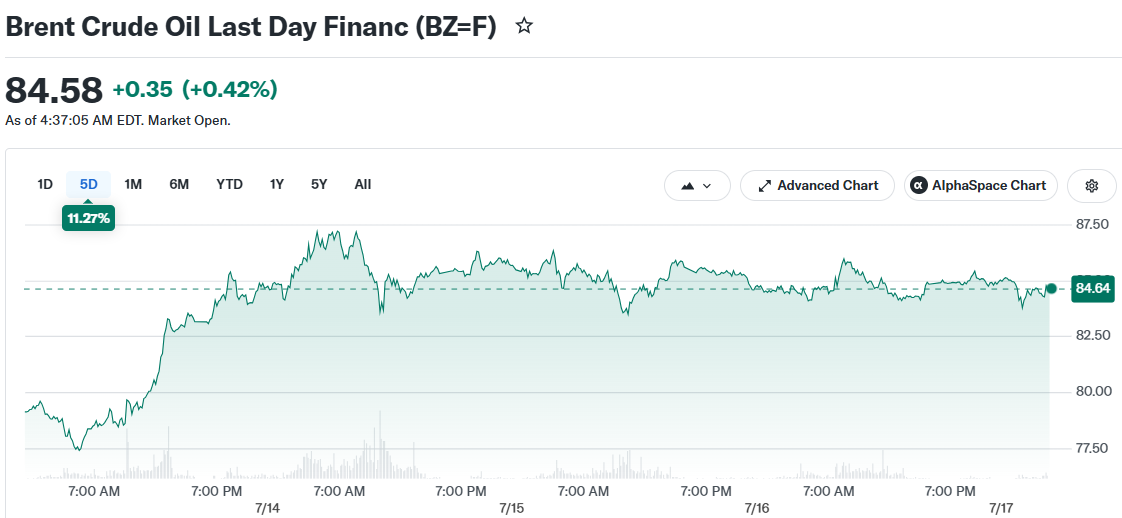
Oil prices moved higher on Friday, capping off a week where both major benchmarks climbed nearly 12%. Brent crude futures rose to around $84.38 per barrel, while U.S. West Texas Intermediate traded near $78.71 per barrel.
The gains came as the United States and Iran exchanged strikes for a sixth consecutive night. The U.S. military said its latest strikes were aimed at degrading Iranian military capabilities.
Iran’s military launched fresh attacks on U.S. facilities in the Middle East on Friday morning, including what it described as its first direct strike in Syria. Tehran also sent missiles and drones toward U.S. military bases in neighbouring countries, including a recently expanded air base in Jordan.
Brent crude is now on track for a third straight weekly gain. WTI is heading for a second consecutive weekly rise.
The Strait of Hormuz is central to global oil supply. Roughly one-fifth of the world’s oil and fuel passes through it.
🚨🇺🇸🇮🇷 Just THREE ships crossed the Strait of Hormuz in 24 hours, down from 110 a day before the war.
-Open-source MarineTraffic data shows only three vessels transited the strait in the past 24 hours, two moving into the Gulf (a cargo ship and a tanker) and one tanker departing… pic.twitter.com/9kINL3sCSU
— Mario Nawfal (@MarioNawfal) July 17, 2026
Vessel traffic through the strait dropped sharply this week after the U.S. reimposed a naval blockade on Iranian ports. That slowdown has added a geopolitical risk premium to prices.
Iran has also told its Houthi allies to be ready to close the Red Sea oil export route. This would happen if the U.S. strikes Iranian power infrastructure, according to three sources cited by Reuters.
“The potential threat of the Red Sea becoming another major supply disruption point is further complicating the global oil outlook,” said Tim Waterer, chief market analyst at KCM Trade.
The International Energy Agency’s Executive Director Fatih Birol said on Thursday that oil security remains a serious concern. “We should be worried, and I am worried, if the situation does not improve in the next few weeks,” he said.
A fragile ceasefire signed in June has effectively collapsed. Regional mediators including Qatar, Egypt and Pakistan are still pursuing talks. Qatar’s defence ministry said its forces thwarted an Iranian missile attack early Friday, with a child injured by shrapnel from interception operations.
U.S. inventory data released this week showed the crude market is tightening. The Energy Information Administration reported that U.S. crude stockpiles fell by 1.7 million barrels in the week ending July 10, bringing total stocks to 409.7 million barrels.
Gasoline inventories also declined by 1.5 million barrels in the same period. Earlier data from the American Petroleum Institute showed a smaller draw of around 564,000 barrels, below analyst expectations.
Despite the sharp weekly gains, some analysts say the market has stayed calmer than the headlines suggest. “There is a lack of urgency in oil circles at present,” said Tamas Varga of PVM Oil Associates.
Technically, analysts at IG said WTI could test the mid-$80s if it holds above key support in the mid-$70s.
The post U.S.-Iran Strikes Push Oil Prices Up Nearly 12% in One Week appeared first on CoinCentral.





