Oil prices climbed on Friday and are on track for one of their biggest weekly jumps in months. The gains come as fighting between the United States and Iran shows no sign of slowing down.
Brent crude futures rose to around $84.79 per barrel on Friday. U.S. West Texas Intermediate traded near $79.78 per barrel. Both benchmarks are up more than 11% for the week.
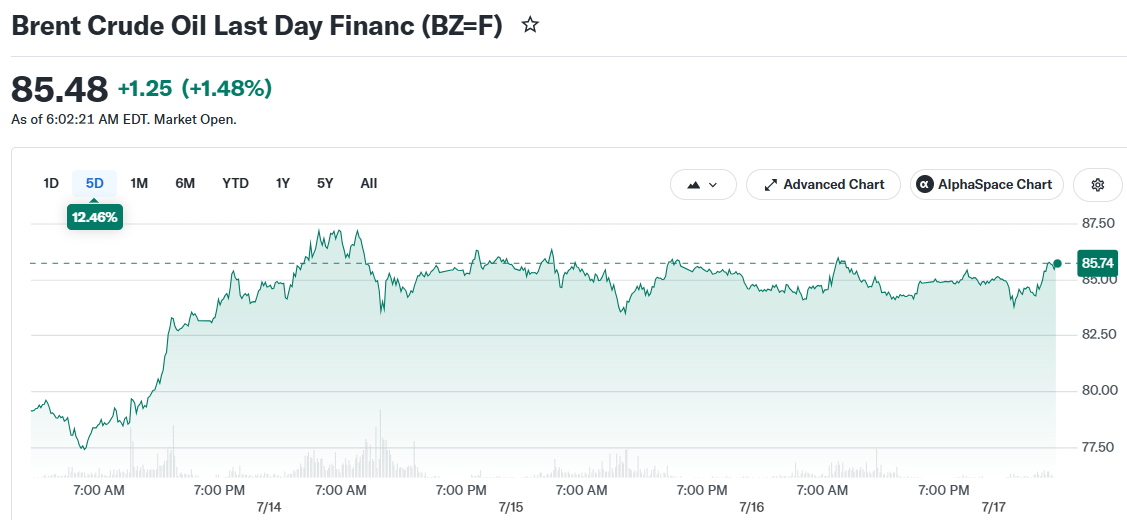
The moves mark the best weekly performance for oil since late April.
U.S. Central Command confirmed it completed its sixth straight night of airstrikes on Iran overnight Thursday. The strikes hit dozens of military targets, including logistics infrastructure and maritime capabilities.
Centcom said more than 50,000 U.S. service members are currently operating across the Middle East. The command described its forces as “vigilant, lethal, and ready.”
U.S. Central Command says its latest wave of strikes against Iran has been completed.
CENTCOM said U.S. forces struck Iranian command centers, air defense sites, missile and drone capabilities, and coastal surveillance facilities to further degrade Iran's ability to threaten… pic.twitter.com/1NlgO7Bav9
— Fox News (@FoxNews) July 16, 2026
Iran responded by launching its own strikes on U.S. facilities in the region on Friday morning. This included Iran’s first direct attack in Syria.
President Trump said earlier this week that U.S. forces would target Iranian infrastructure unless a diplomatic deal was reached. Iran’s military command warned in response that if those threats were carried out, “all the infrastructure in the region will be crushed.”
The Strait of Hormuz is the main focus for oil traders right now. Around 20% of the world’s oil traffic passes through the waterway.
A fragile ceasefire struck in June has now collapsed. Vessel traffic through the strait dropped sharply this week after the U.S. reimposed a naval blockade on Iranian ports.
Iran has also reportedly asked Yemen’s Houthi forces to be ready to shut down the Red Sea oil route if the U.S. strikes Iranian power infrastructure. CNBC could not independently verify this report.
Analysts at Rystad Energy say a limited agreement between the U.S. and Iran remains their base case, but confidence in that outcome has weakened.
Rystad’s senior vice president Jorge León noted that both sides still have economic reasons to avoid a full breakdown. Iran has access to frozen assets and export waivers on the table that it does not want to lose permanently. The U.S. also wants lower oil prices ahead of November midterm elections.
U.S. crude stockpiles fell by 1.7 million barrels in the week ended July 10, according to the Energy Information Administration, with gasoline inventories also declining by 1.5 million barrels.
Diplomatic efforts are continuing, with Qatar, Egypt, and Pakistan reported to be pursuing talks despite the collapse of the June ceasefire.
The post Oil Prices Surge 11% as U.S.-Iran Conflict Threatens Strait of Hormuz Supply appeared first on CoinCentral.





