Oil prices rose for a second straight day on Friday but remained on course for their steepest weekly drop since June, as supply disruptions in the Middle East kept markets on edge.
Brent crude climbed above $96 a barrel, while West Texas Intermediate traded near $99. Both contracts gained around 1% in Asian trading on Friday.
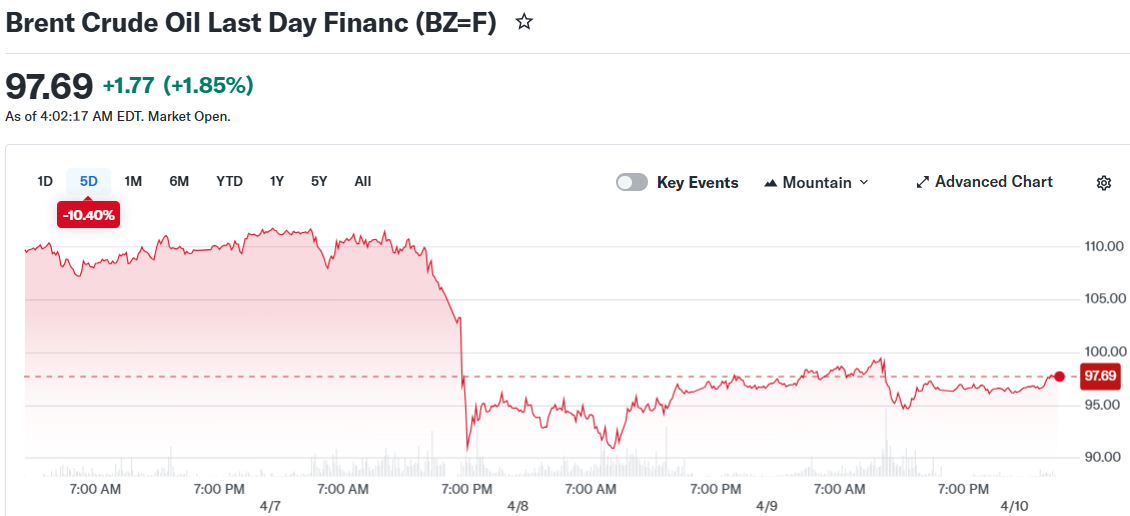
Despite the daily gains, Brent is still down more than 11% for the week. WTI has fallen a similar amount.
The sharp weekly drop came after the US and Iran announced a ceasefire on Tuesday. That news briefly pushed prices lower on hopes that oil flows would resume.
But the situation quickly became more complicated. Within hours of the truce, Israel launched airstrikes on Lebanon, saying its conflict with Hezbollah was not part of the ceasefire agreement.
Iran responded by halting tanker traffic through the Strait of Hormuz again, citing Israel’s strikes as a breach of the deal.
The Strait of Hormuz has been near-closed since late February. That disruption has affected roughly one-fifth of global oil and liquefied natural gas flows, causing a severe supply shock.
PRESIDENT TRUMP:
“There are reports that Iran is charging fees to tankers going through the Hormuz Strait — They better not be and, if they are, they better stop now!” pic.twitter.com/AE18nX5M7i
— The Kobeissi Letter (@KobeissiLetter) April 9, 2026
Saudi Arabia’s press agency confirmed that attacks on energy infrastructure have cut the kingdom’s production capacity by around 600,000 barrels a day. That is about 10% of its normal crude exports.
Strikes on a pumping station serving the East-West pipeline also cut throughput by 700,000 barrels this week. Saudi Arabia had been using that pipeline to export crude via the Red Sea, bypassing the Strait of Hormuz.
“The drop in East-West pipeline throughput weakens Saudi’s Hormuz bypass strategy and highlights persistent supply risks,” said Mohith Velamala, a global oil analyst at BloombergNEF.
Kuwait also reported intercepting drone attacks, with some vital facilities targeted.
Countries that rely heavily on Middle Eastern oil are now dipping into reserves. Japan will release about 20 days of oil from stockpiles in May. China gave state refiners the go-ahead to tap commercial reserves. India’s largest private refiner has started capping fuel purchases at pumps.
Markets are now focused on planned US-Iran talks in Islamabad, where Vice President JD Vance is expected to lead the US delegation on Saturday.
However, Iranian media reported on Friday that Tehran denied a negotiating delegation had arrived. Iran also said talks would stay suspended until the US upholds commitments on the Lebanon ceasefire.
President Trump said he was “very optimistic” about reaching a deal and described Iran’s leaders as “much more reasonable” than their public statements suggest.
Trump also warned Iran on social media not to charge fees to tankers using the Strait of Hormuz.
Iran’s new supreme leader said Iran “will definitely bring the management of the Strait of Hormuz to a new stage,” though the exact meaning of that statement was unclear.
“The market is refocusing on the reality of flows through the Strait of Hormuz, which remain far from normalized and are unlikely to snap back quickly,” said Rebecca Babin, senior energy trader at CIBC Private Wealth Group.
Oil prices have swung by an average of more than $9 a day since the conflict began, the largest daily moves in years.
The post Oil Prices Rise Friday But Head for Biggest Weekly Loss Since June as Hormuz Stays Disrupted appeared first on CoinCentral.





