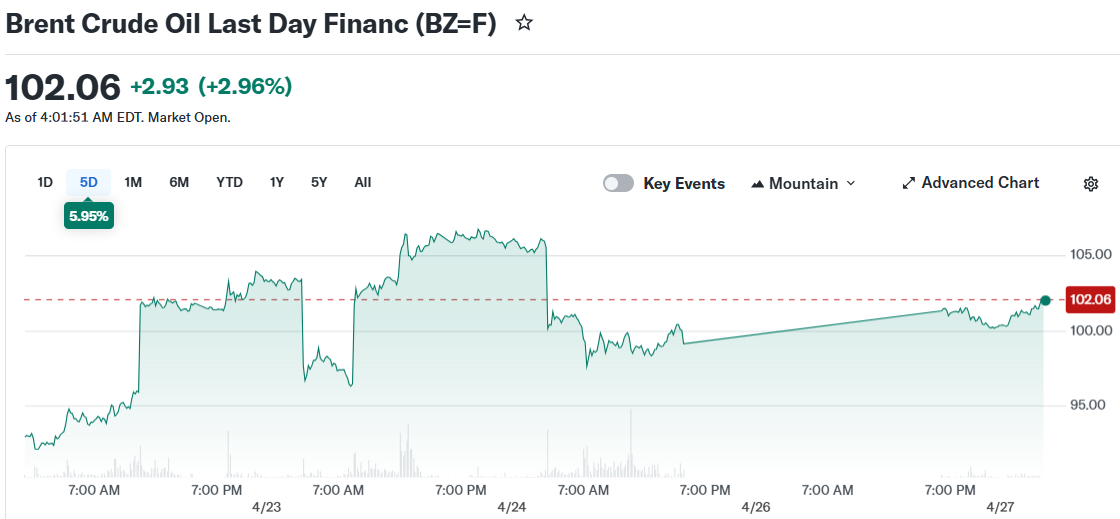
Oil prices jumped on Monday as efforts to restart US-Iran peace talks broke down over the weekend, leaving the Strait of Hormuz effectively closed for a ninth straight week.
Brent crude rose as much as 2.5% to $107.97 a barrel. West Texas Intermediate advanced toward $97. Prices trimmed some gains after Axios reported that Iran had sent the US a new proposal to reopen the strait.
The Strait of Hormuz, a narrow waterway through which roughly 20% of the world’s crude supply passes, has been under a joint blockade by both the US and Iran since late February. Daily transits through the strait have fallen to near zero.
The standoff began after Iran moved to block the strait in response to US-Israeli military operations. A ceasefire has been in place since early April, but the blockade has continued with no resolution in sight.
President Donald Trump canceled a planned trip by his envoys Jared Kushner and Steve Witkoff to Pakistan, which had been serving as a mediator. Trump later told reporters that Iran had “offered a lot, but not enough.”
BREAKING: Iran through Pakistani mediators has given the US a new proposal for reaching a deal on the reopening of the Strait of Hormuz and ending the war, per Axios.
Details include:
1. Nuclear negotiations are postponed for a later stage under the deal
2. President Trump is…
— The Kobeissi Letter (@KobeissiLetter) April 27, 2026
Iranian President Masoud Pezeshkian said Iran would not enter “imposed negotiations under threats or blockade.” The two sides have not engaged in direct hostilities since the ceasefire but remain far apart on key issues.
Iran’s new proposal, reported by Axios, would reopen the strait and end the war, while pushing nuclear talks to a later stage. The US has previously demanded Iran hand over its uranium and stop all nuclear activities — demands Tehran has largely rejected.
The International Energy Agency has described the conflict as causing the biggest energy supply shock in history. A loss of 1 billion barrels is already considered all but certain, more than double the emergency inventories governments have released.
Shortages of liquefied petroleum gas have hit India. Airlines have cut flights. Fertilizer and fuel supplies have also been disrupted.
“The Strait is still very much under siege, with traffic halted,” said Mona Yacoubian of the Center for Strategic and International Studies. “We’re in this purgatory, where it’s just stalemated.”
Robert Yawger, director of energy futures at Mizuho Securities, said consolidation above $100 is where prices are heading, adding that the chances of a deal grow slimmer with each passing day.
US Central Command said American forces intercepted a sanctioned vessel in the Arabian Sea on Saturday. A total of 38 ships have been redirected since the blockade began.
The US Treasury also confirmed it would not renew a waiver that had allowed purchases of Russian and Iranian oil currently at sea, removing a temporary buffer that had helped offset some supply disruptions.
On Friday, the US sanctioned Chinese refinery Hengli Petrochemical over its ties to Iran, a move that came weeks ahead of an expected summit between Trump and Chinese President Xi Jinping. Hengli denied any trade with Iran.
Iran exports most of its crude to China, with private Chinese refiners buying the cheaper barrels.
Haris Khurshid, chief investment officer at Karobaar Capital, said Brent crude will likely trade between $100 and $115 a barrel unless there is broader regional escalation.
Trump is expected to hold a national security meeting Monday to discuss the stalled negotiations.
The post Oil Prices Rise as Hormuz Strait Stays Blocked and US-Iran Talks Collapse appeared first on CoinCentral.





