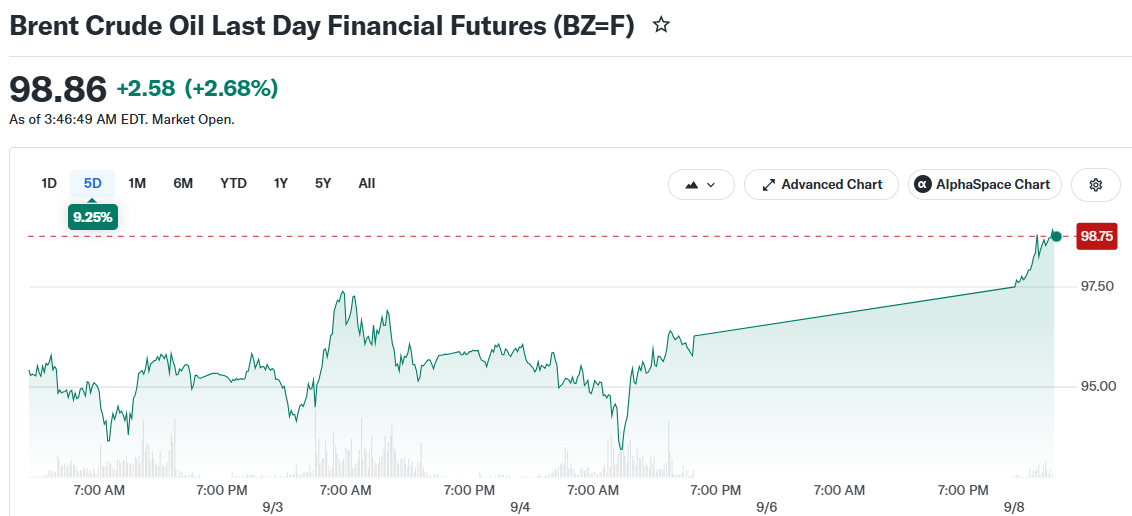
Oil prices surged on Tuesday as Iran escalated its warnings against Gulf energy infrastructure, pushing Brent crude close to the $100 mark.
Brent futures rose 1.6% to $98.73 a barrel, while U.S. West Texas Intermediate climbed 2.9% to $94.14. Brent had already settled nearly 1% higher on Monday after briefly touching $98.
The moves follow a weekend of tit-for-tat strikes between the U.S. and Iran, including attacks on shipping in the Persian Gulf.
Iran threatened to respond to what it called U.S. “economic warfare” by imposing a maritime exclusion zone across the Persian Gulf. Iranian Parliament Speaker Mohammad Baqer Qalibaf warned that American oil and gas companies operating in the region face direct exposure.
“The oil and gas production chain here is sprawling, accessible, and exposed,” he said. “Strike our assets, and you get struck. We’ve already proven it.”
Mohsen Rezaei, secretary of Iran’s Supreme National Security Council, posted on X that Washington had received a “clear warning” and that any further economic warfare would trigger a maritime exclusion zone extending to the perimeter of the U.S. blockade.
The Strait of Hormuz, through which a large share of the world’s oil passes, is the focal point for traders right now.
BREAKING: Iran rejects the proposal, saying Iran sets the conditions of any proposal and the US "repeated violations" and shifting positions make talks currently impossible, per a senior source in Tehran to RT.
Iran says all conditions must be met first, which remain unchanged:… https://t.co/yUhzRTH2Jr
— The Hormuz Letter (@HormuzLetter) September 7, 2026
Iran said it plans to introduce a new restricted zone in the Gulf along with an alternative shipping corridor. That raised fears of slower tanker traffic through the waterway.
Iran also said a deal with Oman over Hormuz shipping arrangements is close, describing it as in its final stages. The deal would include a temporary safe route through the strait.
However, markets remain skeptical that diplomacy will resolve the broader conflict quickly.
U.S. Energy Secretary Chris Wright said about 8 million barrels a day on average is still leaving the Persian Gulf, though tankers are frequently switching off their transponders to avoid detection.
On Monday, Saudi Aramco’s oil facilities in Jazan, near the Red Sea, came under fresh attack. The strike did not cause major damage, but it was the latest in a series of hits that have already forced a nearby refinery to halt operations.
Oil prices are now up more than 30% since the conflict began at the end of February. Brent gained 8% last week, while WTI rose nearly 10%.
The market is watching closely for any signs of escalation or a diplomatic breakthrough that could shift the supply outlook.
The post Iran Threatens Gulf Energy Infrastructure as Brent Crude Nears $100 a Barrel appeared first on CoinCentral.





