Oil prices dropped more than 1% on Tuesday as traders balanced hopes of a ceasefire between the U.S. and Iran against fresh attacks and a new threat to shipping routes.
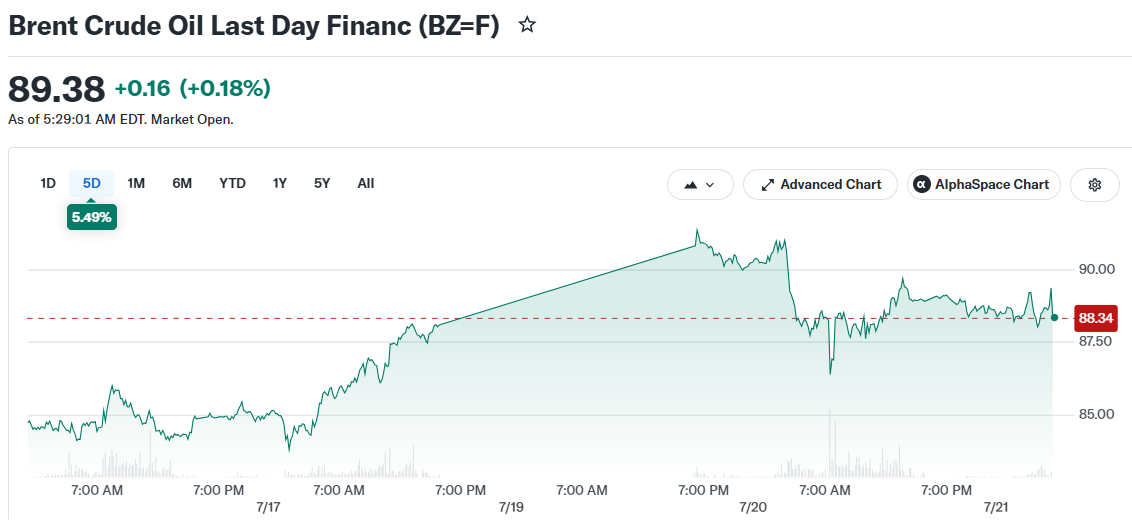
Brent crude fell to around $88 a barrel, while U.S. West Texas Intermediate dropped to roughly $82. Both contracts had settled higher the day before, with Brent briefly trading above $90 a barrel.
Mediators are proposing a 10-day ceasefire between Washington and Tehran, according to a senior Iranian official who confirmed the proposal to Reuters. The aim is to revive an interim deal signed on June 17 and pave the way for a lasting agreement.
BREAKING: Mediators are working to push the US and Iran into a new ceasefire, per WSJ.
Details include:
1. Mediators are worried the US and Iran could settle into a pattern where they keep conflict below the level of all-out war but disrupt regional economies indefinitely
2.…
— The Kobeissi Letter (@KobeissiLetter) July 20, 2026
The conflict began on February 28 with U.S.-Israeli strikes on Iran. U.S. Central Command confirmed it had now carried out ten consecutive days of strikes on Iranian military targets, with explosions reported in Bandar Abbas, Qeshm Island, and Konarak.
Despite the ceasefire proposal, major differences remain between the two sides. U.S. President Donald Trump warned of further retaliation after several U.S. soldiers were killed in the conflict.
On Tuesday, a tanker in the Strait of Hormuz was struck by an unknown projectile, forcing its crew to abandon ship. Iran’s Islamic Revolutionary Guards Corps claimed responsibility. Vessel crossings through the strait have been falling.
The Strait of Hormuz is one of the world’s most critical oil shipping routes. Any sustained disruption there would affect global crude supply flows.
Yemen’s Houthi movement, backed by Iran, announced plans to impose a naval blockade on Saudi Arabia. This would affect the Bab al-Mandab Strait, a chokepoint that handles around 12% of global trade.
“The threats of a naval blockade on Saudi Arabia by the Houthis are significant because they raise the risk of disruption to another major oil exporter,” said Tim Waterer at KCM Trade.
Analysts at ING said markets were not yet convinced the blockade would be effective. However, they warned it would raise insurance costs for vessels in the region. Ships would need to reroute around Africa if the blockade took hold.
SEB Research noted that the latest U.S. strikes could be a negotiating tactic before a deal is reached. But they cautioned that a more drawn-out stalemate remains a real risk, with continued energy flow uncertainty and higher oil prices possible.
Geopolitical risk continues to support crude prices. But gains have been limited by past patterns where Middle East tensions eased before causing lasting supply disruptions.
Markets are now watching weekly U.S. oil inventory data from the American Petroleum Institute on Tuesday and the Energy Information Administration on Wednesday for signs of fuel demand in the world’s largest oil consumer.
The post Oil Prices Fall as U.S.-Iran Ceasefire Talks Begin – Houthis Threaten Saudi Blockade appeared first on CoinCentral.





