Oil prices dropped again on Thursday, extending steep losses from the day before, as hopes grew for a peace deal between the US and Iran that could reopen a key global oil route.
Brent crude fell $2.16, or about 2.1%, to $99.11 a barrel. US West Texas Intermediate slipped $2 to $93.08. Both benchmarks had already fallen more than 7% on Wednesday, hitting two-week lows.
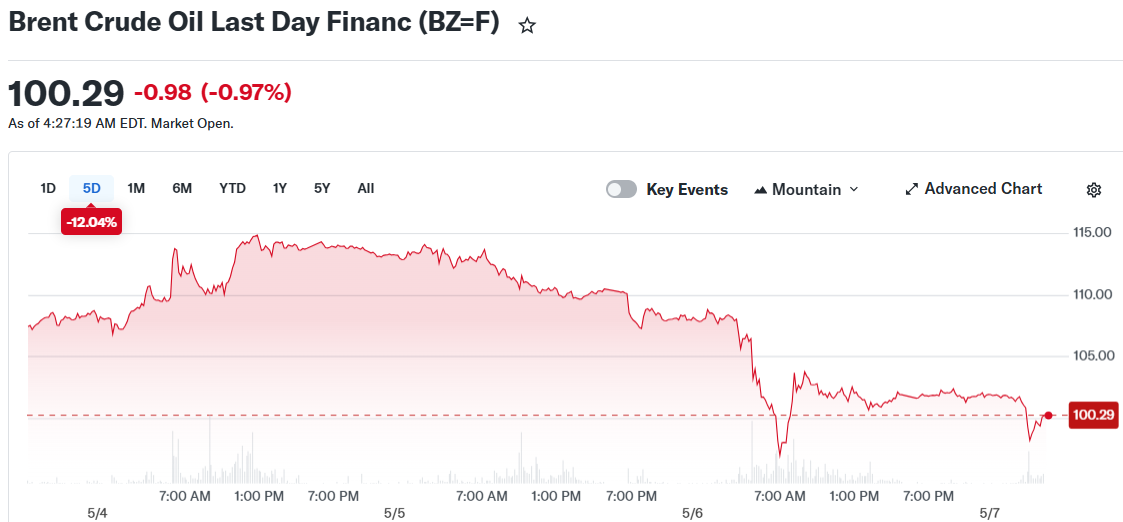
The main driver was a flurry of reports suggesting Washington and Tehran are close to agreeing on a one-page memorandum of understanding to formally end the war.
Axios reported that the White House expected Iran’s response within 48 hours. CNN said Tehran was expected to reply to the US proposal by Thursday. An Iranian foreign ministry spokesperson confirmed Iran would send its response to mediators.
Saudi Arabia’s Al Arabiya also reported that both sides had reached understandings to ease the US blockade of Iranian ports in exchange for gradually reopening the Strait of Hormuz. Reuters could not immediately verify that report.
BREAKING: President Trump releases a statement amid reports that a deal to end the Iran War is imminent.
"Assuming Iran agrees to give what has been agreed to… Epic Fury will be at an end." pic.twitter.com/5YnAkg1Y8a
— The Kobeissi Letter (@KobeissiLetter) May 6, 2026
The Strait of Hormuz is one of the world’s most important oil shipping lanes. Roughly one-fifth of global oil trade passes through it. Any disruption or restoration of traffic there directly affects global supply and prices.
Earlier this week, the US paused a military operation to restore commercial traffic through the strait after Iran responded with force.
Markets have been reacting sharply to every headline from the negotiations. Priyanka Sachdeva, senior market analyst at Phillip Nova, said oil markets have been “stuck between diplomacy and disruption for more than two months.”
She said a formal deal could cause oil prices to fall sharply as geopolitical risk premiums disappear from the market.
ING analysts said a deal restoring Hormuz traffic would reduce supply-risk premiums, but any delay could quickly push prices back up.
US Treasury Secretary Scott Bessent urged China this week to push Iran to reopen the strait. He said President Trump and China’s Xi Jinping will discuss the matter when they meet next week.
Hiroyuki Kikukawa of Nissan Securities Investment said peace talks are likely to continue at least until the US-China summit, but the outlook after that remains unclear.
Weekly US oil inventory figures from the Energy Information Administration offered some support to prices. Crude stockpiles fell by 2.3 million barrels in the week ended May 1, to 457.2 million barrels.
Analysts had expected a larger draw of 3.4 million barrels, so the smaller-than-expected drop capped any price recovery.
Gasoline inventories fell by 2.5 million barrels. Distillate stocks, which cover diesel and heating oil, declined by 1.3 million barrels.
The EIA report also showed strong US petroleum exports, pointing to continued demand for American supplies as Middle East energy flows remain disrupted.
Iran had said on Wednesday it was reviewing the US proposal, which sources said would formally end the war but leave unresolved key US demands, including Iran suspending its nuclear program.
The post Oil Prices Drop 2% as US and Iran Approach Peace Deal Over Strait of Hormuz appeared first on CoinCentral.





