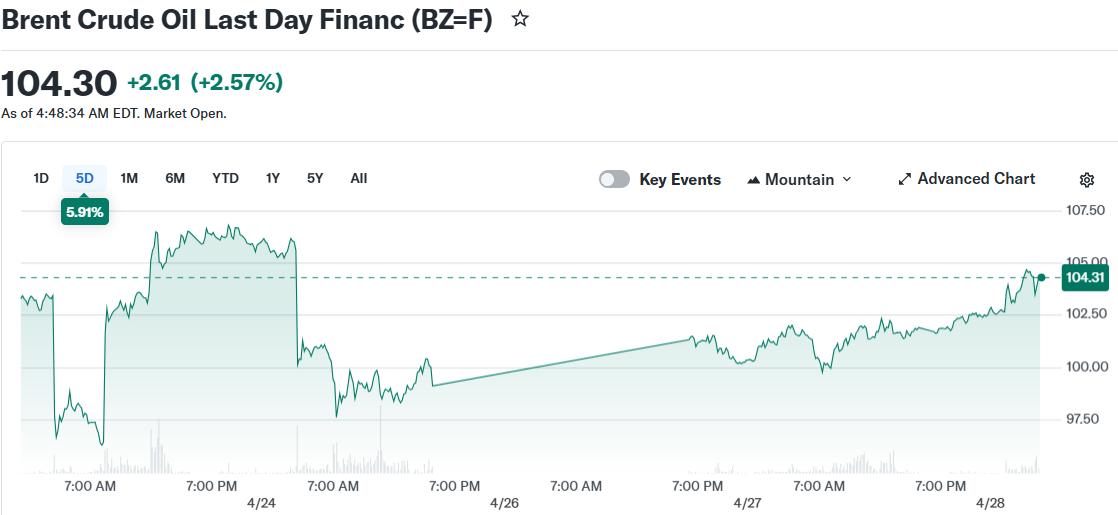
Oil prices climbed to a three-week high this week after talks between the US and Iran over reopening the Strait of Hormuz hit a wall.
Brent crude rose above $111 a barrel in London trading. West Texas Intermediate pushed past $98. Both contracts had already gained between 2% and 3% in the session before.
Iran put forward a proposal to end the conflict and reopen the strait. The plan involved the US lifting its naval blockade, agreeing to a new legal framework for ships passing through the waterway, and guaranteeing no future military action against Iran.
US President Donald Trump convened a meeting to review the proposal. But reports from the Wall Street Journal and Reuters said Trump and his national security team were unhappy with the offer.
BREAKING: President Donald J. Trump is reportedly dissatisfied with Iran’s latest proposal, arguing it fails to address key realities, particularly the nuclear issue, according to reporting cited by The New York Times.
He is also said to be frustrated that Iran’s Supreme…
— The Iranian Letter (@TheIranianzg3z) April 28, 2026
The main sticking point was Iran’s request to delay talks on its nuclear program. Ending nuclear enrichment and preventing Iran from building a nuclear weapon are the two core US demands in the conflict.
Secretary of State Marco Rubio said Iran still appeared to want control of the Strait of Hormuz and called that unacceptable. He made the comments in a Fox News interview that aired Monday.
The Strait of Hormuz has been effectively shut since early April. Before the conflict, roughly one-fifth of the world’s oil and liquefied natural gas passed through the narrow waterway daily.
Daily transits through the strait have dropped to near zero. The closure has cut global crude and gas flows, pushed energy prices higher, and raised inflation concerns.
Two Iran-linked tankers intercepted by US forces near Sri Lanka last week have turned around in the Indian Ocean. The US naval cordon on Iranian shipping began on April 13 and has turned away dozens of vessels.
Energy strategist Florence Schmit at Rabobank said the Iran proposal appeared to be going nowhere. She noted that markets were shifting from a risk-off mood toward a “bleaker risk-on outlook.”
Iran is now running out of places to store its crude oil, according to data analytics firm Kpler. With exports stalled by the US blockade, storage capacity is filling up fast.
US Treasury Secretary Scott Bessent said Iran’s oil industry was “starting to shut in production.” He added in a social media post that production would “soon collapse” and that Iran was likely to face gasoline shortages.
Pakistan has been mediating peace talks between Washington and Tehran. Plans for further talks fell through over the weekend, leaving the timeline for future negotiations unclear.
The US-Israel conflict with Iran is approaching the 60-day mark. Market analyst Linh Tran at XS.com noted that any real progress in negotiations could trigger a sharp price correction.
Central bank meetings in Japan and the US are also in focus this week, with higher oil prices expected to raise concerns about energy-driven inflation.
The post Oil Prices Hit Three-Week High as US-Iran Strait of Hormuz Talks Stall appeared first on CoinCentral.