Oil prices continued to rise on Friday as the U.S.-Iran conflict entered its third month with no sign of a deal, keeping one of the world’s most important oil routes shut down.
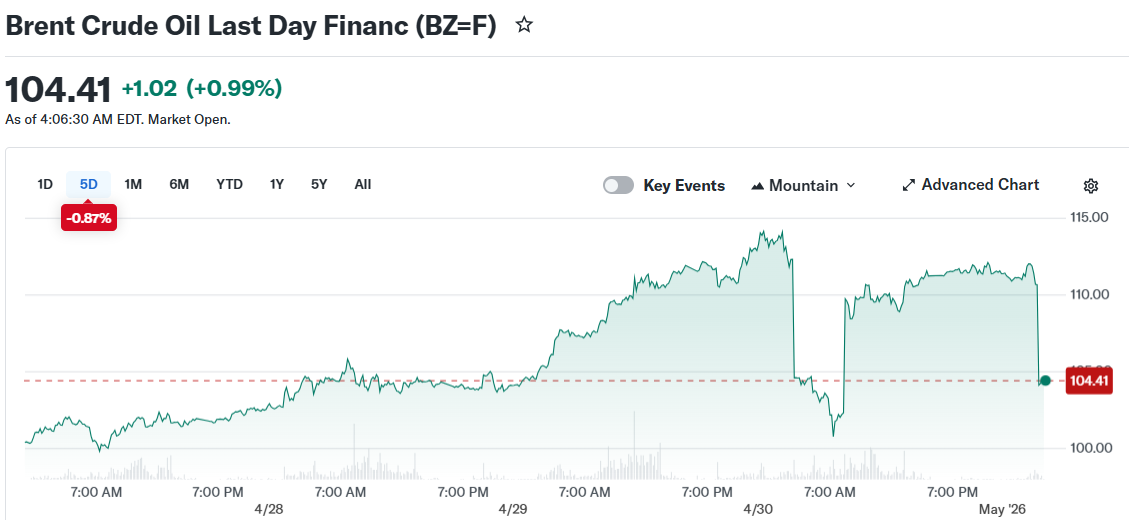
Brent crude for July rose above $111 a barrel. West Texas Intermediate was near $106. Both benchmarks are up around 12% this week alone and have gained more than 25% over the past two weeks.
The Strait of Hormuz, which carried roughly 20% of the world’s oil before the war began, remains effectively closed. That has rattled global energy markets and caused sharp price swings in recent weeks.
President Donald Trump said the U.S. naval blockade of Iranian ports is working and will stay in place. He had earlier said he hoped economic pressure would push Iran toward a deal, but talks have largely stalled.
IRAN WAR “FINAL BLOW” BRIEFING REPORTED
CENTCOM Commander Adm. Brad Cooper briefed President Trump in the Situation Room on a potential “final blow” to Iran, per Fox News.
Axios reports Trump currently views the naval blockade as his main leverage, but could consider military… pic.twitter.com/szyy4nwpzt
— Coin Bureau (@coinbureau) May 1, 2026
Iran’s Supreme Leader Mojtaba Khamenei issued a rare public statement on Thursday, saying Iran will not give up its nuclear or missile programs. He also said Tehran will keep control of the Strait of Hormuz.
The statement left little room for near-term de-escalation. A ceasefire between the U.S. and Iran remains in place, but diplomatic progress has been limited.
ConocoPhillips Chief Financial Officer Andy O’Brien warned analysts on Thursday that some countries could face “critical shortages” of oil as soon as June.
He explained that tankers that left the Persian Gulf in late February have now reached their destinations. That buffer is gone, and countries that depend heavily on imports may feel the squeeze within weeks.
“We are going to start to see some import-dependent countries potentially start to face critical shortages as we get into the June-July time frame,” O’Brien said.
Reports on Thursday also showed Trump was weighing more military options, including forcibly reopening the strait, launching additional strikes against Iran, or seizing Iranian enriched uranium through a special forces operation.
Analysts at ANZ noted that the gap between paper oil prices and physical market prices is narrowing. That means real-world supply tightness is starting to show up for the first time since the conflict began.
U.S. crude exports surged to a record last week as buyers worldwide turned to American producers to replace lost Middle Eastern barrels.
Japan’s top currency official said authorities are ready to intervene in crude oil futures markets, where speculative trading has been affecting the yen. Japan stepped into the currency market on Thursday to buy yen, causing the largest drop in the Bloomberg Dollar Spot Index since January.
Trading volumes were below normal in Asian markets on Friday, with several major economies including China, Germany, and France closed for Labor Day.
Brent’s June contract expired Thursday after hitting a four-year high of over $126 a barrel.
The post Oil Prices Hit 2022 Highs as U.S.-Iran War Keeps Strait of Hormuz Closed appeared first on CoinCentral.





