Oil prices crossed $100 a barrel this week as U.S. military strikes on Iran continued and shipping disruptions in the Middle East showed no signs of letting up.
Brent crude futures settled at $100.69 on Thursday, up 7% on the day. That marks the first close above $100 since May 22. West Texas Intermediate jumped 6.2% to $92.19 a barrel.
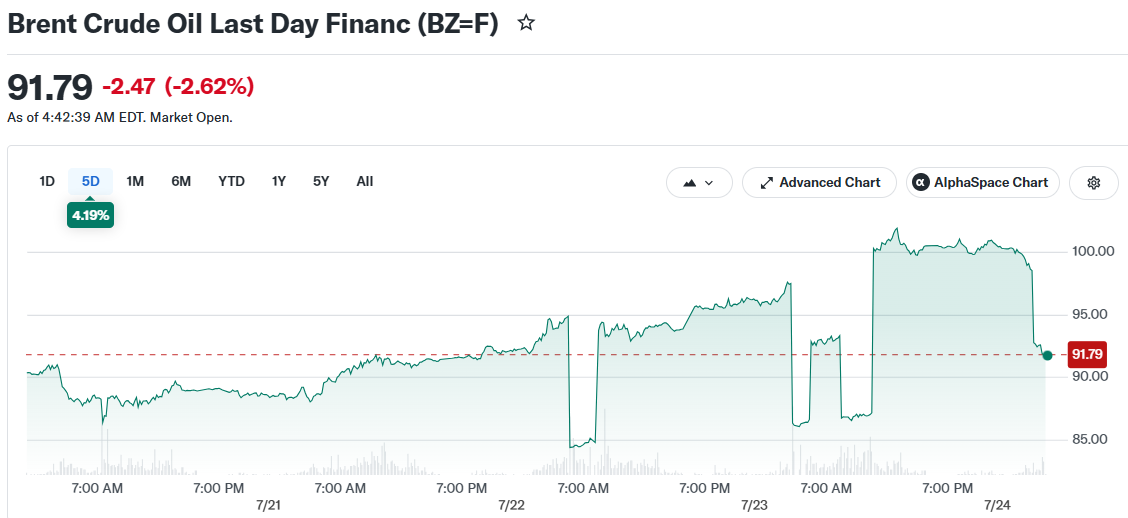
By Friday, both benchmarks pulled back. Brent fell 1.7% to $99.01 and WTI dropped to $90.64 as traders took some profits after a strong week.
Brent is still up nearly 14% for the week, its third straight week of sharp gains.
U.S. strikes on Iran ran for 12 consecutive days as of Thursday, disrupting oil shipping traffic through the Strait of Hormuz. The waterway is one of the most critical chokepoints for global oil supply.
🇺🇸🇮🇷 BREAKING: Trump says all ship and cargo damages will be paid from Iranian money held by the United States.
"These damages may be very substantial but, nevertheless, this is the fair and equitable thing to do," Trump said on Truth Social.
Iran has over $100 BILLION in… pic.twitter.com/ajEV8VOUaF
— Coin Bureau (@coinbureau) July 23, 2026
Yemen’s Houthi group, backed by Iran, claimed two attacks on Saudi tankers in the Red Sea. The attacks targeted the Bab al-Mandap Strait, a route Saudi Arabia had been using to bypass Hormuz disruptions.
President Trump on Thursday threatened “major military punishment” against Iran and the Houthis. He also said Iranian money would be used to pay for damages to affected ships and cargo.
Iran rejected a U.S.-backed ceasefire proposal, according to a New York Times report. Tehran said it would not accept a temporary deal, citing disagreements over control of the Strait of Hormuz.
The proposal had been delivered by Iraqi Prime Minister Ali al-Zaidi. Regional mediators including Pakistan and Qatar have continued diplomatic efforts despite worsening conditions.
Goldman Sachs analyst Daan Struyven said prices are expected to hold most of their gains through July and August, supported by lower Middle East output and summer travel demand.
If the conflict does not ease, Goldman warns Brent could exceed $120 a barrel in the fourth quarter and average $100 through 2027 if Hormuz remains disrupted.
J.P. Morgan analyst Natasha Kaneva said current prices only reflect a modest geopolitical premium. She noted that global demand has also fallen, with China cutting oil imports and scaling back petrochemical operations.
Higher crude prices lifted oil company shares. Exxon Mobil rose 2% and Chevron gained 1.2%. French oil major TotalEnergies reported its highest second-quarter profits in more than two years.
The S&P 500 fell 1.4% on Thursday, with energy gains failing to lift the broader market.
Iran’s government is reportedly preparing for the possibility of a wider conflict with the United States, as Washington’s strikes entered their 13th consecutive day by Friday.
The post Oil Prices Top $100 a Barrel as U.S. Strikes on Iran Disrupt Strait of Hormuz Shipping appeared first on CoinCentral.





