TL;DR:
The most important research conducted to date on the state of real-world asset tokenization has arrived with a conclusion that contradicts much of the sector’s consensus: the problem is not supply, but distribution. Centrifuge published the results of a survey of 150 active operators in issuance, distribution, liquidity, and infrastructure, conducted between February and March of this year. The findings challenge several of the dominant narratives around the path to market growth.
The first relevant data point is geographic. According to the Centrifuge report, 79% of operators based in North America expect tokenized assets under management to exceed $150 billion by the end of 2027. In Europe, including the United Kingdom and Switzerland, that figure drops to 54%. Eric Manoukian, research analyst at Messari, attributes the difference to the regulatory context: while the United States is experiencing a fervent institutional push, Europe operates under a framework like MiCA that has so far proven more restrictive than growth-oriented.
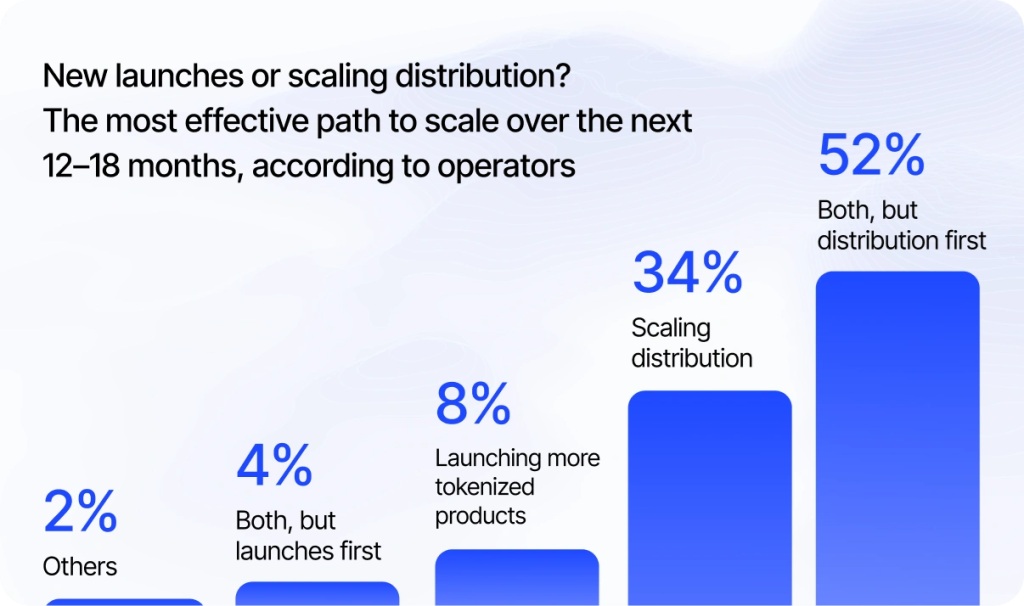
The most widely agreed-upon finding from the Centrifuge survey is also the most direct: 86% of respondents prioritize scaling the distribution of existing products over launching new tokenized assets over the next 12 to 18 months.
52% indicate that both dimensions matter, but that distribution must come first. Only 8% place new launches as the top priority. Filippo Armani, lead researcher at Dune, links this finding to onchain activity: every time a tokenized asset is integrated as collateral or incorporated into a liquidity strategy, its utility grows and its distribution accelerates.
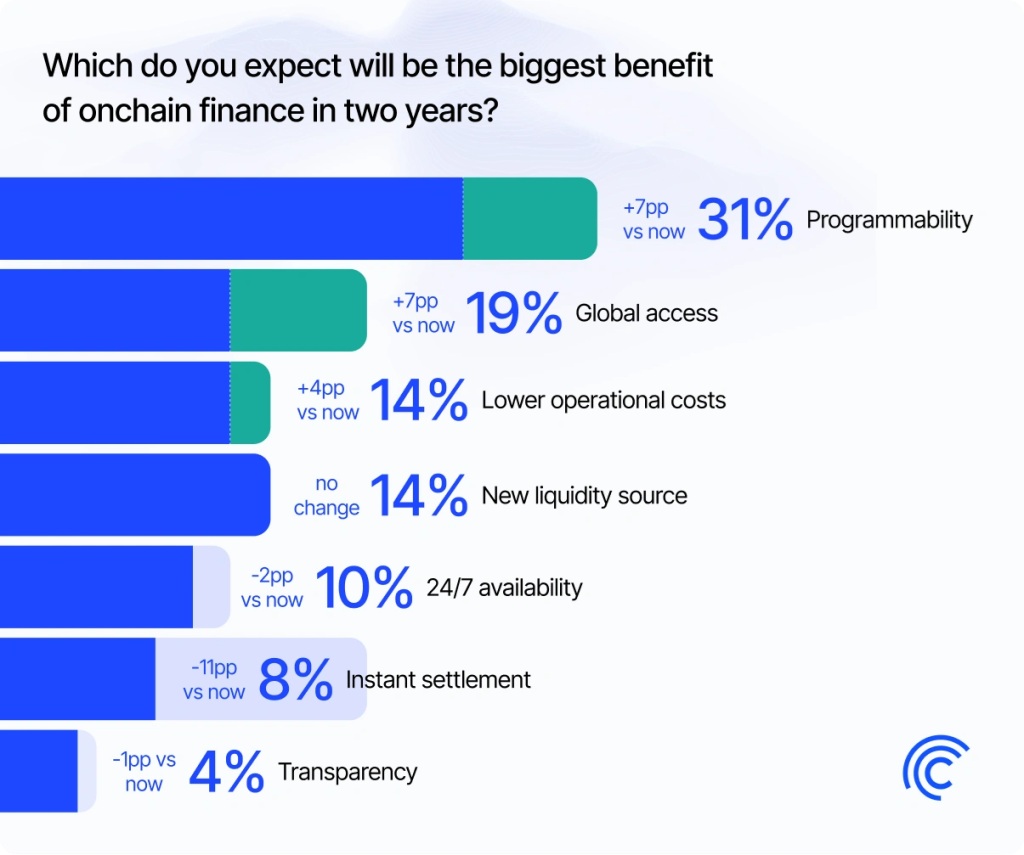
Programmability is the sector’s great structural differentiator. It went from being a minor advantage to leading with 31% of the projected benefits of onchain financing over the next two years, an increase of seven percentage points. Accessibility also rose seven points to reach 19%. In the opposite direction, settlement speed fell eleven points to 8%, the largest drop recorded in the survey. What once defined the value proposition of tokenization is beginning to be treated as a minimum standard, not as a competitive differentiator.





