TL;DR
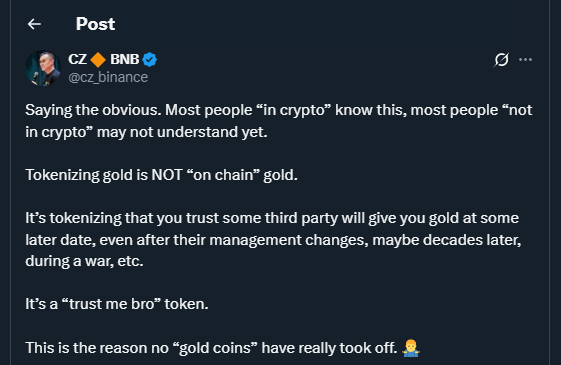
In a sharp rebuke, CZ used his X account on October 23 to question the legitimacy of Peter Schiff’s gold-backed token. He said tokenized gold isn’t real “on-chain gold” but a claim that relies on trusting a third party to deliver physical gold in the future. For CZ, this approach contradicts the essence of blockchain, which was created to remove intermediaries.
Peter Schiff, a long-time Bitcoin skeptic, recently announced his intention to launch a gold-backed token along with a neobank. Through this system, users will be able to purchase gold via an app, store it in a vault, and transfer ownership using blockchain technology. A debit card would allow spending directly from their gold balance, turning the metal into a digital means of payment.
Schiff argues that gold is the most reliable store of value, claiming that tokenization simply modernizes access to a historically stable asset. He insists that this initiative represents a safer alternative to volatile cryptocurrencies like Bitcoin, which he continues to predict will eventually “go to zero.”
CZ reaffirmed his stance that blockchain’s power lies in trustless transactions. He emphasized that the gold token’s reliance on custodians reintroduces counter-party risk, something crypto was designed to eliminate. In his words,
“If someone has to hold your asset for you, you don’t own it; they do.”
The Binance founder warned that depending on vault managers and centralized entities exposes investors to potential fraud, regulatory seizures, and operational failures. From a pro-crypto perspective, CZ’s position underscores that true financial sovereignty comes from holding assets natively on-chain, without redemption promises or institutional guarantees.

This debate reflects a deeper divide within the digital asset space. Tokenized real-world assets attempt to bridge traditional finance and blockchain, offering tangible backing and familiarity for conservative investors. However, critics argue that such systems compromise decentralization and repeat the same trust dependencies of legacy finance.
For crypto advocates, Bitcoin and similar assets remain the purest expression of digital ownership, borderless, censorship-resistant, and fully autonomous.





