TL;DR
Compound Finance, one of the most established decentralized lending protocols in the industry, approved a $52 million budget and completely renewed its leadership team with the goal of attracting institutional capital. With this decision, it will attempt a strategic shift toward real-world assets, integration with partners and credit infrastructure for traditional financial markets.
The protocol was a pioneer in decentralized lending since its launch in 2018, popularizing yield generation on crypto deposits without intermediaries. Since then, it has processed approximately $480 billion in deposits and loan volume. However, its total value locked (TVL) collapsed from a peak of $12 billion in September 2021 to the current $1.2 billion, while competitors such as Aave accumulate more than $14.8 billion according to data from DeFiLlama.
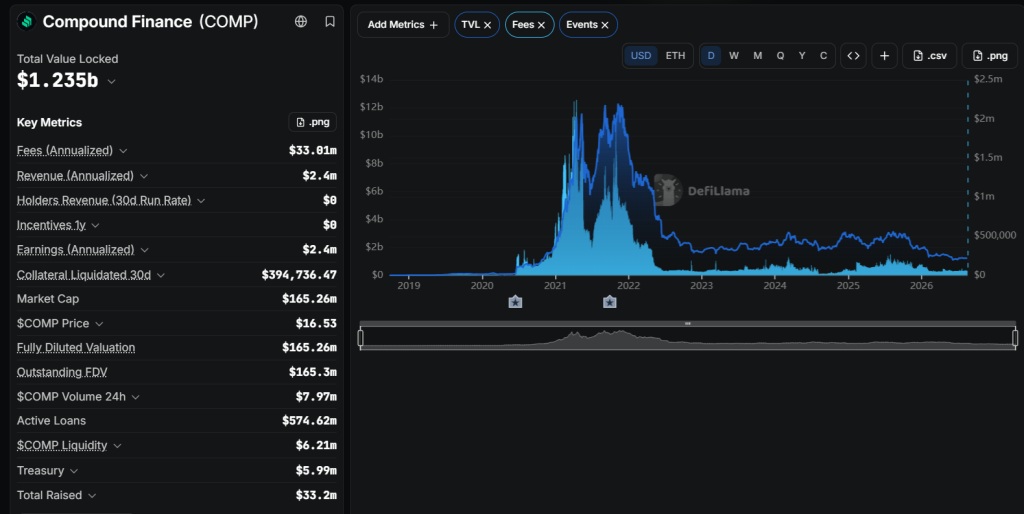
The sector context is far from favorable. TVL across the entire DeFi ecosystem fell by more than a third since the beginning of the year, to approximately $70 billion, driven by a broad correction in cryptocurrencies, yield compression and a series of exploits, including the $292 million hack of KelpDAO in April. Nevertheless, some projections from Standard Chartered estimate that the sector will reach $2.7 trillion by 2030, with tokenized real-world assets being one of the fastest-growing segments.
Compound’s new leadership team brings in Christopher Donovan as chief operating officer, former COO of Near Foundation; Steven Liu, who scaled Maple Finance from $500 million to $5 billion in assets, as chief product officer; and Aaron Schnarch, former CEO of Coinbase Custody, as chief executive officer. Names from Anchorage Digital, HSBC and Broadridge Financial also join the team.

“DeFi is a remarkable innovation; however, it has achieved limited institutional adoption,” Schnarch stated in a press release. “Current offerings do not meet the standard of traditional finance, particularly regarding regulatory compliance and technical requirements.”
Ran Hammer, chief business officer at Orbs, interpreted Compound’s bet as a logical response to the ecosystem’s transformation. “Retail participation is a fraction of what it once was, and the chain has quietly become a space for settlement, execution and interaction among financial institutions,” he said.
The approved budget is the largest in the history of Compound’s decentralized autonomous organization, a signal of commitment that analysts consider necessary, though insufficient on its own: institutions, warned Himanshu Sahay of Arch Lending, evaluate structures, not teams.





