TL;DR:
Decentralized finance protocol Compound officially launched its institutional lending market. The platform runs on the Compound v3 version and delivers borrowing parameters tailored to large corporate participants.
1/ Introducing the Compound Institutional Market.
Market-leading LTVs. Curated collateral. Proven infrastructure.
Institutional Market is now live
https://t.co/Oq2O0nxeOD pic.twitter.com/wbD4oUn1mv
— Compound Foundation (@Compound_xyz) September 8, 2026
The initiative introduces higher loan-to-value (LTV) ratios than those available in traditional pools. The Compound Foundation stated that this model seeks to overcome the limitations of standard decentralized finance setups, which enforce identical risk parameters across all users regardless of balance sheet size.
The basket of eligible collateral during this initial stage focuses on four assets: ETH, wstETH, WBTC, and cbBTC. Protocol technical documentation notes that this curated list aims to streamline corporate treasury allocations within well-defined underwriting frameworks.
The execution environment is powered by Compound v3 smart contracts. The development entity specified that this iteration accounts for four consecutive years in production without technical downtime or confirmed security exploits.
Unlike open-access markets, institutional users will have access to dedicated communication lines. Each onboarded firm will receive an assigned point of contact to coordinate integrations, risk parameter updates, and governance notices.
Initial liquidity providers in the USDC stablecoin will receive targeted incentives. The Compound report confirms that early depositors will earn the base market yield alongside limited bonus rewards, which will phase out once the initial liquidity cap is reached.
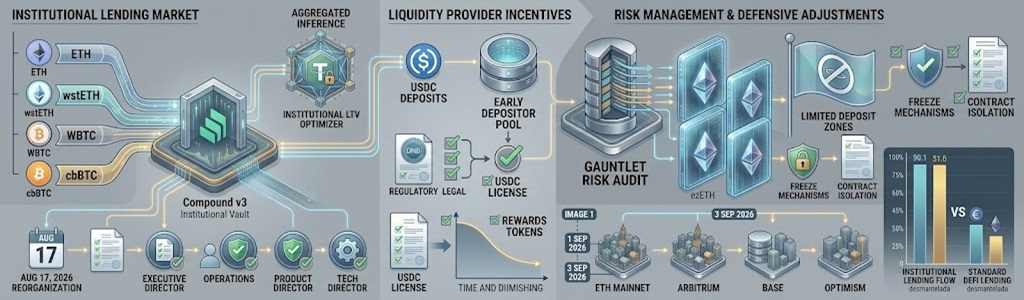
The rollout coincides with an internal restructuring recently ratified by Compound governance. On August 17, 2026, the decentralized autonomous organization (DAO) approved a development program backed by a $52 million budget.
This capital allocation formalized a new executive roster: Aaron Schnarch took over as Chief Executive Officer, joined by Christopher Donovan as Chief Operating Officer, Steven Liu as Chief Product Officer, and Leo Eikelman leading the engineering team as Chief Technology Officer.
The treasury program aims to build native integrations for real-world assets (RWA) and optimize capital efficiency. Development team reports highlight that these tools are intended to simplify how financial institutions technically bridge on-chain products into legacy back-office systems.
In tandem, protocol governance carried out defensive adjustments across its broad-market lending pools. On August 22, 2026, risk management firm Gauntlet recommended reducing the supply cap to zero for seven collateral listings in ETH-denominated markets.
The change rolled out in phases: September 1, 2026, on the Ethereum mainnet, and September 3, 2026, across Layer-2 networks Arbitrum, Base, and Optimism.
The supply restriction applies to four liquid staking and liquid restaking tokens: ezETH, pufETH, rETH, and tETH. Gauntlet audit data shows that none of the impacted positions individually exceeded $500,000 in total value locked when the advisory was published.
Setting a supply cap to zero halts new collateral deposits while leaving open borrow lines fully intact. Protocol documentation clarifies that existing borrowers retain the ability to repay debt balances and withdraw collateral without incurring penalties or changes to their liquidation thresholds.
The Compound Institutional Market is active on mainnet, pending future governance votes to onboard additional collateral types during the upcoming quarterly parameter review.





