Crypto funding rate markets are evolving with the explosive growth of decentralised derivatives platforms like Hyperliquid and the entry of funding rate trading from Pendle. In particular, two structural forces can be attributed to the funding rate market dynamic, creating predictable trading opportunities:
BitMEX exhibited the most stable funding rates compared to Binance and Hyperliquid, hitting the 0.01% anchor more often than others. For volatility, ETH was the “higher beta” play compared to BTC.
Master the market’s structure—not sentiment—to succeed in funding rate trading.
Nine years ago, BitMEX invented the perpetual swap, which fundamentally changed how people trade cryptocurrencies. In our previous Q2 Derivatives Report, “The Evolution of Funding Rates: 9 Years of BitMEX’s XBTUSD Funding Rate Analysis,” we detailed its journey from a volatile, speculative instrument to becoming a mature, stable market. Now, we are witnessing the next stage of that evolution: the emergence of a dedicated funding rate trading market.
Funding rate trading allows traders to move speculating on price and trade the underlying mechanics of the market itself. But what drives these mechanics? In this report, we take a deep dive into the dynamics of the perpetual swap market and the funding rate formula to uncover crucial insights for crypto traders.
Our findings point to two powerful factors influencing the funding rate: the gravitational pull of the 0.01%/8-hour funding rate formula anchor and the sheer weight of institutional arbitrage capital that enforces it. This report will explore these findings, backed by data from Q3 2025, and outline key takeaways for traders based on this structural understanding.
As we explored in our previous report, the crypto funding rate market for major tokens like Bitcoin has reached maturity. In the early days of perpetual swaps, Bitcoin funding rates frequently exceeded 0.2%/8-hour during bull markets, translating to an annualised rate of over 200%.
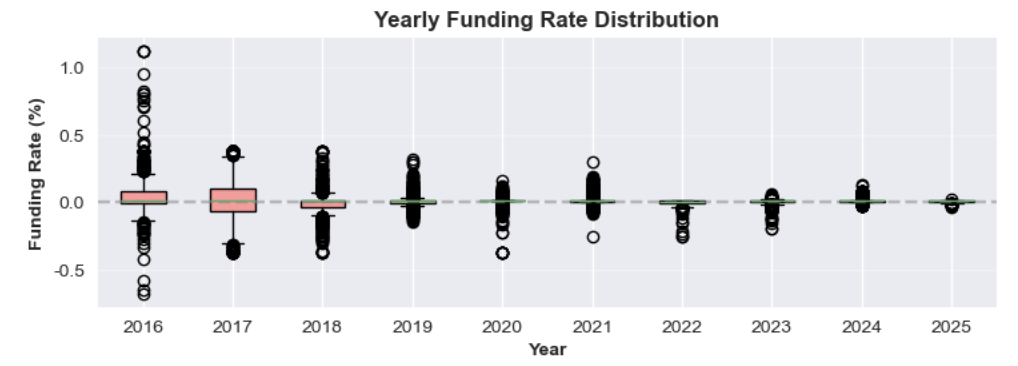
Over the years as the market deepened and more institutional capital flowed in, this volatility subsided. The 2024-2025 cycle established a new normal: the average funding rate now consistently hovers around a baseline of 0.01%/8-hour. This occurs when the perpetual contract’s premium is minimal, causing the rate to default to its interest rate component—a sign of a systematically efficient financial market.
Why has the funding rate market changed so drastically? This phenomenon can be explained by two key factors:
Let’s explore these concepts in more detail.
Funding rates for perpetual contracts are designed to keep the contract’s price aligned with the underlying asset’s spot price. On BitMEX and some other venues, they are calculated every eight hours using a formula that combines two main components: the Premium Index and the Interest Rate, which are balanced by a clamping mechanism.
The general formula for funding rates across exchanges like BitMEX, Binance, and Hyperliquid is:
F = P + Clamp(I−P,−0.05%,0.05%)
Below is a breakdown of each part of the formula.
Clamp(x, min, max)
: A buffer mechanism to ensure that the difference between the Interest Rate and the Premium Index (I−P) doesn’t become too extreme. The difference is capped at a maximum of +0.05% and a minimum of -0.05% which prevents the funding rate from swinging too wildly.A key feature of the formula is its ability to stabilise the funding rate at the baseline Interest Rate (0.01%) when the market is relatively calm.
The Golden Rule: The funding rate (F) will be exactly 0.01% as long as the Average Premium Index (P) stays within the range of -0.04% to +0.06%.
Inside this range, the Clamp Function perfectly cancels out the premium or discount, defaulting the funding rate back to the Interest Rate.
Example A: Slight Premium
Let’s assume the Average Premium Index (P) is +0.02%.
Example B: Slight Discount
Now, let’s assume the Average Premium Index (P) is -0.03%.
Both examples show that regardless of whether the Average Premium Index (P) sits slightly above or below the funding rate, the final rate always sits at 0.01%.
A crucial design aspect of many perpetual contracts is their inherent positive bias. This means long positions often still pay short positions a small amount, even when the contract is trading at a slight discount. This happens because the fixed positive Interest Rate (I=0.01%) acts as a floor.
This explains why the funding rate is often a small positive number (e.g., 0.005%) instead of a negative one.
Example: Discount on Perpetuals with Positive Funding Rate
Let’s assume the market is bearish and the Average Premium Index (P) drops to -0.045%.
In this example, the funding rate is still positive despite the perpetual contract trading below the spot price. Longs are still paying shorts, demonstrating the structural bias that favours short positions with positive bias.
For the funding rate to become neutral or negative, the market discount must be significant enough to overcome the positive bias from the Interest Rate.
While the funding rate formula defines the rules, arbitrage capital enforces them. The current open interest for major tokens (Bitcoin, Ethereum, Solana) stands in the tens of billions across top crypto exchanges. Arbitrage players, from proprietary trading firms to DeFi protocols like Ethena, have billions in capital ready to be deployed the moment funding rates become attractive. When the perpetual price trades at a high premium, these institutions sell the perpetual and buy the spot asset to collect the high funding rate and compress the premium back.
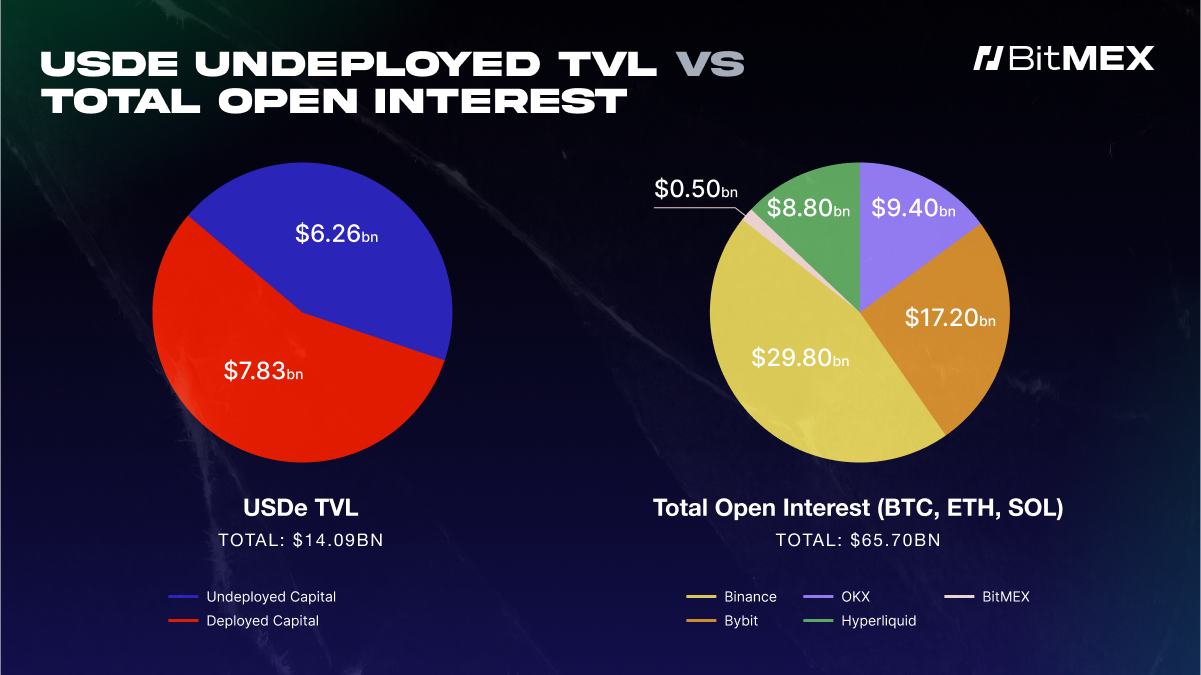
Figure 2: Ethena (USDe) Total Value Locked vs the Total Open Interest for BTC, ETH, and SOL on major crypto exchanges on 25 September 2025
Figure 2 provides colour on how Ethena’s USDe, a major funding rate arbitrage player, plays a significant role in explaining short-lived high funding rates. The pie chart on the left reveals that Ethena (USDe) has $7.83 billion in capital ready to be deployed. The right pie chart shows the total open interest across the top exchanges (on 21 September 2025), which sits at $65.70 billion. When comparing the two charts, it’s clear that a single protocol such as Ethena plays a massive role – its undeployed capital is as much as 12% of the market’s open interest.
Whenever funding rates become attractive, institutions deploy their available capture to capture profit. This arbitrage strategy pushes the high funding rates back down.
In short, the large pool of undeployed capital acts as a ceiling for funding rates – preventing it from staying high for long.
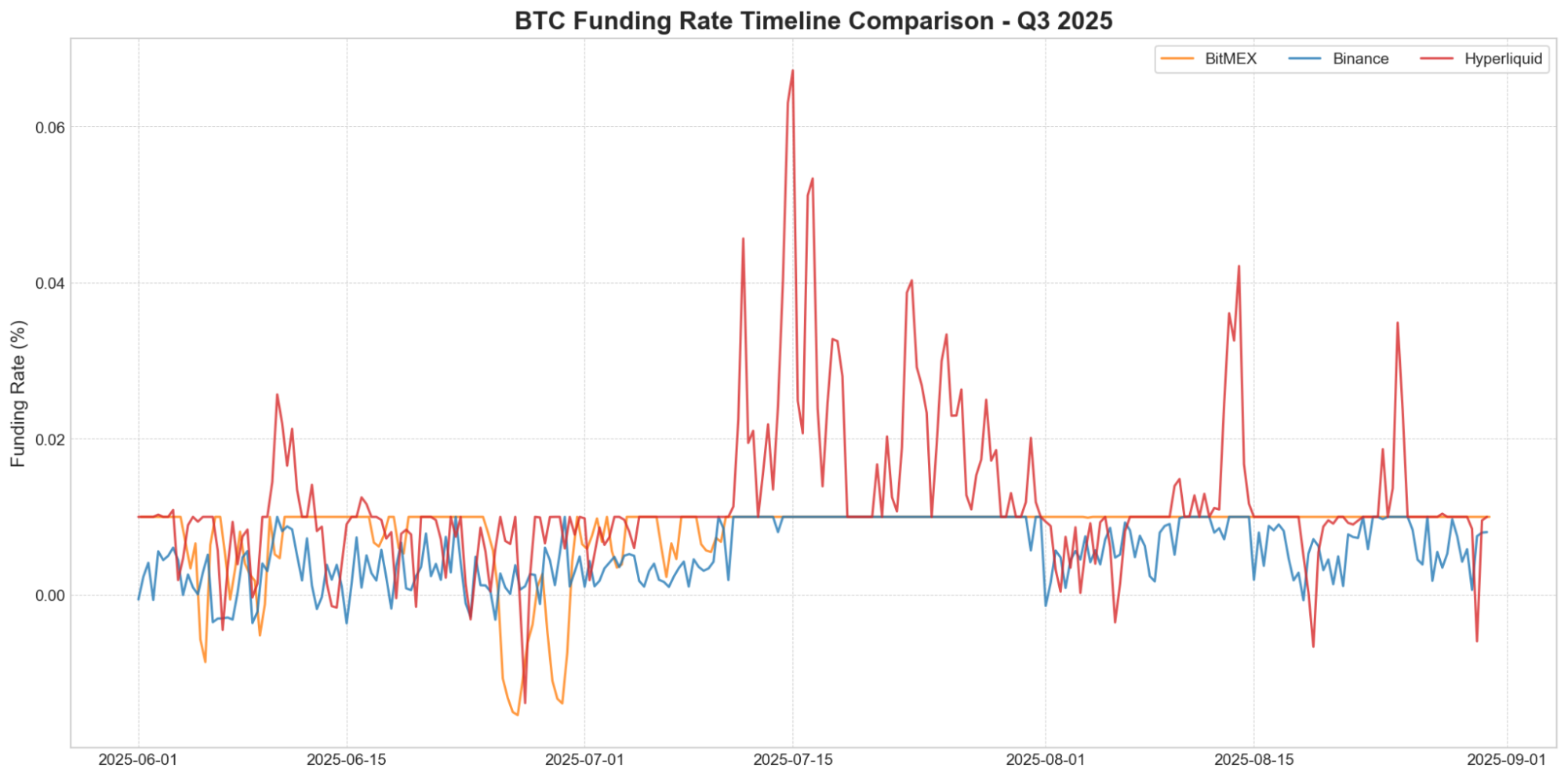
To analyse whether the above thesis on funding rates’ floor and ceiling stand true, we analysed funding rate data from Q3 2025 across BitMEX, Binance, and Hyperliquid. This confirmed the two core theories discussed in the previous section:
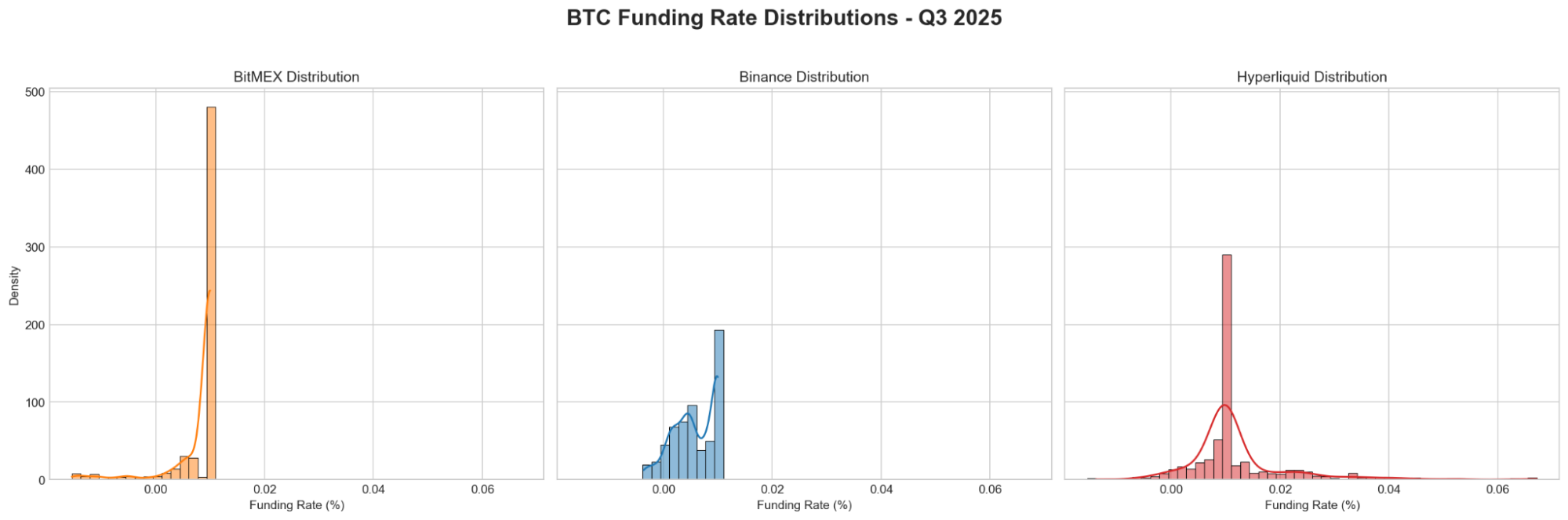
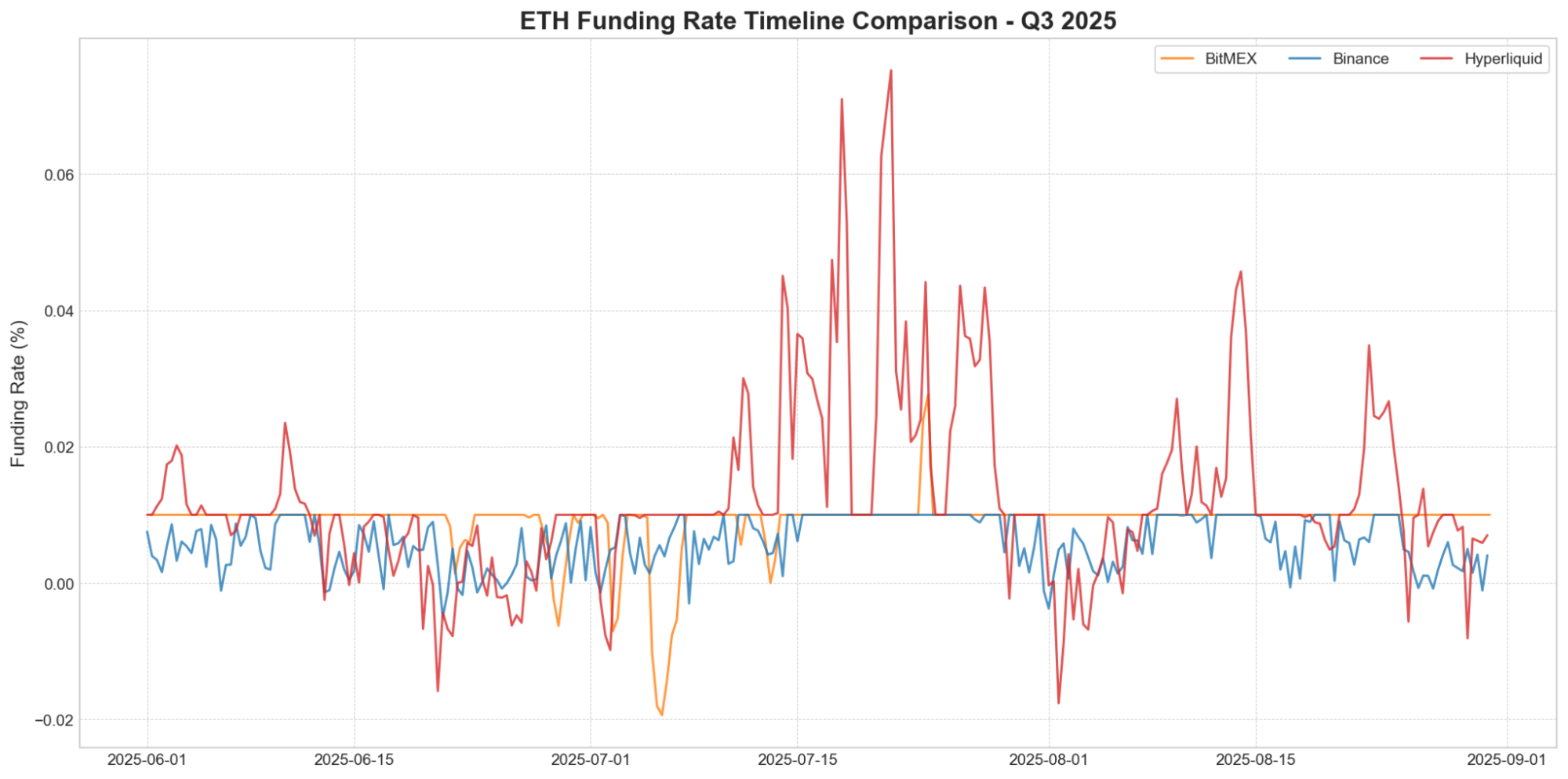
Figure 3 and figure 5 shows the BTC and ETH funding rates history in Q3 2025, which confirms two of our core findings. First, funding rates for all three venues remained positive for the vast majority of the quarter, a direct result of the formula’s structural positive bias. Second, it shows that funding rates on BitMEX and Binance have been tightly anchored around the 0.01% baseline, illustrating the powerful effect of arbitrage capital.
The notable exception is Hyperliquid, whose funding rate exhibits significant volatility and frequent spikes far above this baseline—a phenomenon we will dissect in the next section.
|
Exchange |
Mean |
Std Dev |
Min |
Max |
Freq. of 0.01% |
Freq. Positive |
|
BitMEX |
0.0081% |
0.0049% |
-0.0154% |
0.0100% |
78.19% |
93.83% |
|
Binance |
0.0057% |
0.0039% |
-0.0036% |
0.0100% |
30.70% |
92.54% |
|
Hyperliquid |
0.0120% |
0.0097% |
-0.0139% |
0.0672% |
39.45% |
95.98% |
|
Exchange |
Mean |
Std Dev |
Min |
Max |
Freq. of 0.01% |
Freq. Positive |
|
BitMEX |
0.0090% |
0.0045% |
-0.0194% |
0.0276% |
87.52% |
95.12% |
|
Binance |
0.0060% |
0.0038% |
-0.0050% |
0.0100% |
31.71% |
92.68% |
|
Hyperliquid |
0.0126% |
0.0131% |
-0.0176% |
0.0752% |
33.57% |
88.81% |
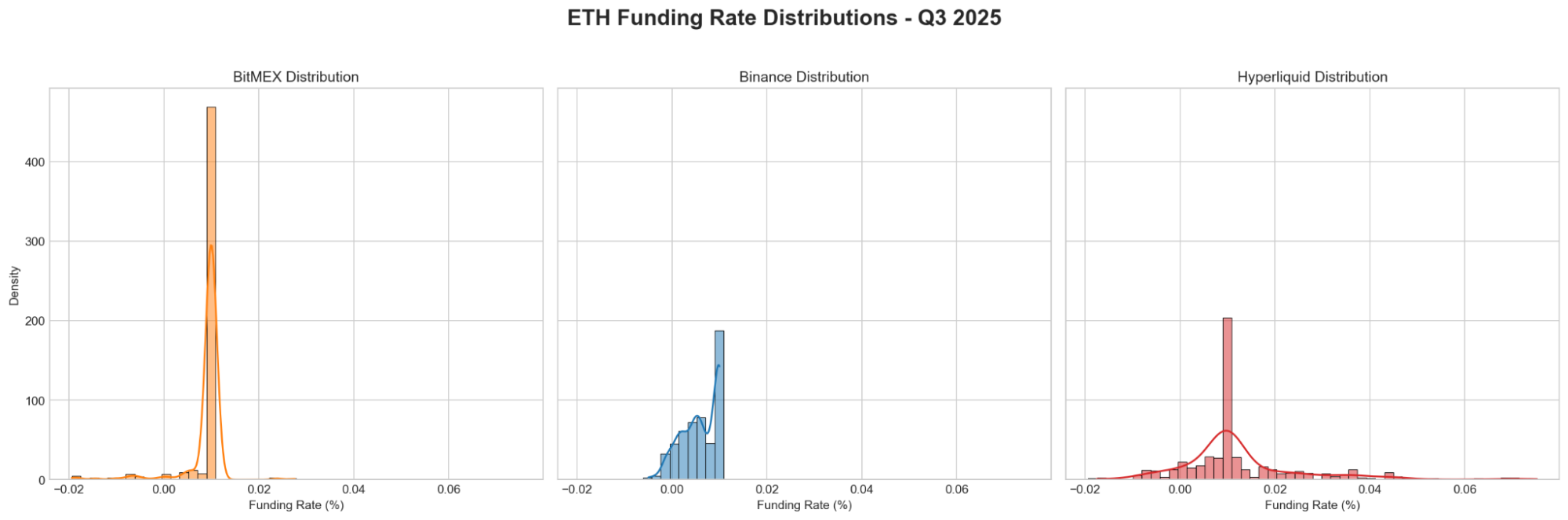
The above charts clearly show discrepancies between funding rate stability when comparing BitMEX with other exchanges like Hyperliquid and Binance.
While the funding rates for both assets followed similar overall trends across exchanges, the data reveals a key difference: ETH funding rates were the “higher beta” play during Q3 2025:
Understanding this market structure provides a framework for identifying high-probability trades. Instead of predicting sentiment, traders can bet on the enforcement of the market’s own rules.
A core finding is that funding rates are overwhelmingly positive—our Q3 2025 data shows this is true over 92% of the time. This isn’t random; it’s a direct result of the formula’s +0.01% interest component, which provides a constant tailwind. Even if you are extremely bearish, remember that a positive funding rate below 0.01% already means the perpetual is trading at a discount to spot. For the rate to turn negative, the market must overcome this built-in positive drift.
Therefore, if a marketplace like Boros shows a near-zero implied funding rate, going long is a structurally advantaged position compared to shorting and hoping for a sustained negative rate. In this scenario, the funding rate formula is not your friend—it’s actively working to push the rate back into positive territory.
Just as the formula creates a soft floor, the availability of large institutional capital creates a hard ceiling. As soon as funding rates climb sigtnificantly above the 0.01% baseline, they advertise a double-digit annualised yield that is irresistible to arbitrators.
Billions in capital from institutions and DeFi protocols are constantly monitoring for these opportunities. When a premium appears, they simultaneously short the perpetual and buy the spot asset, a trade that rapidly compresses the premium and forces the funding rate back down. This means that while rates can spike, these spikes are inherently unstable and short-lived. Betting on sustained high rates is a bet against a vast, efficient, and well-capitalised segment of the market.
Funding rate trading has newly arrived in the crypto industry, and at BitMEX, we are excited to see the next evolution of crypto derivatives. Our analysis shows that succeeding in the funding rate market comes not from predicting chaotic sentiment, but from mastering the market’s underlying structure.
Two core factors—the funding formula’s gravitational pull to 0.01% and the large pool of arbitrage capital that enforce it—have created a remarkably predictable environment. By understanding why rates are anchored and why negative rates are anomalies, traders can move beyond price speculation and exploit the high-probability opportunities embedded in the very architecture of the market BitMEX pioneered nine years ago.
To be the first to know about our new listings, product launches, giveaways and more, we invite you to join one of our online communities and connect with other traders. For the absolute latest, you can also follow us on Twitter, or read our blog and site announcements.
In the meantime, if you have any questions please contact Support who are available 24/7.
The post The Anchor and the Ceiling: Understanding the Structure of Funding Rates appeared first on BitMEX Blog.