TL;DR:
Negotiations around stablecoin regulation in the United States have entered their most sensitive phase. Crypto industry and banking sector representatives met separately on Capitol Hill to review a compromise draft tied to the Clarity Act, whose full text has not yet been disclosed to the public.
Crypto trade groups met first with the Senate Banking Committee, while banking representatives were scheduled to do the same the following day. These consecutive sessions reflect lawmakers’ urgency to close a regulatory framework ahead of a potential April deadline.
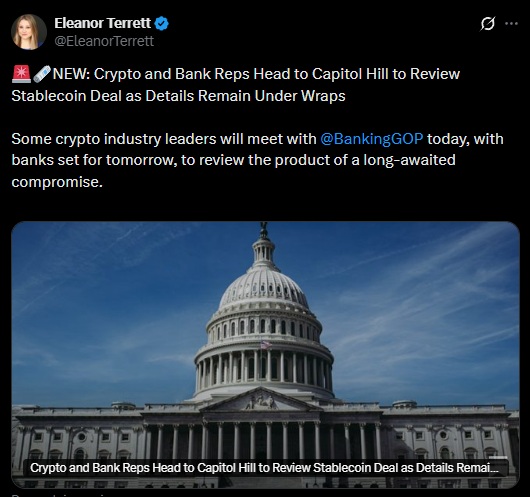
The deal is the product of weeks of negotiation between senators Thom Tillis and Angela Alsobrooks and the White House. Uncertainty persists, however: according to a banking source, even the participants themselves are unaware of the final details of the provisions, indicating that key elements are still being evaluated behind closed doors.

One of the most contentious points is whether crypto companies should be allowed to offer yields for holding stablecoins. Banks are firmly opposed to this possibility, arguing that yield-bearing stablecoins could draw deposits away from traditional institutions and limit their lending capacity. As a result, the draft would contemplate prohibiting yields generated by idle stablecoin balances.
Senator Cynthia Lummis confirmed that terms associated with conventional banking, such as “deposits” and “interest,” will be removed from the legislative language. In parallel, the White House Council of Economic Advisers completed a study on the impact of stablecoins on bank liquidity. Early signals suggest that the results could contradict the argument that stablecoins would trigger a significant flight of deposits, which would strengthen the crypto industry’s position in the negotiations.

While the United States calibrates its regulations, other markets are moving forward. Hong Kong’s central bank is reviewing dozens of applications to license a first group of stablecoin issuers, even as stronger restrictions remain in place on the Chinese mainland.
Investor Stanley Druckenmiller stated in an interview that stablecoins could become the backbone of payments worldwide given their efficiency and lower costs.





