TL;DR:
Michael Egorov, founder of Curve, published a proposal to address the chaos triggered by the KelpDAO exploit. Since the incident, in which approximately $292 million in assets were lost and billions were drained from Aave, the DeFi industry has debated who should absorb the losses when a protocol accumulates debt without sufficient backing. Lido, Mantle, and Aave itself have considered direct contributions, emergency loans, and token allocations. Egorov proposes a different route: converting that debt into a tradable investment product.
The specific case serving as his laboratory is the CRV-long market on LlamaLend, which accumulated bad debt in October 2025 and left the vault with a deficit of approximately $700,000, preventing lenders from fully withdrawing their funds.
According to Egorov, those deteriorated tokens are not dead assets. If the price of CRV rises, the collateral can be recovered and properly liquidated. If it falls, the backing does not deteriorate in the same way as a traditional debt position. This gives the vault a structure similar to that of an option, with upside potential if the collateral rebounds and a relative floor if it does not.
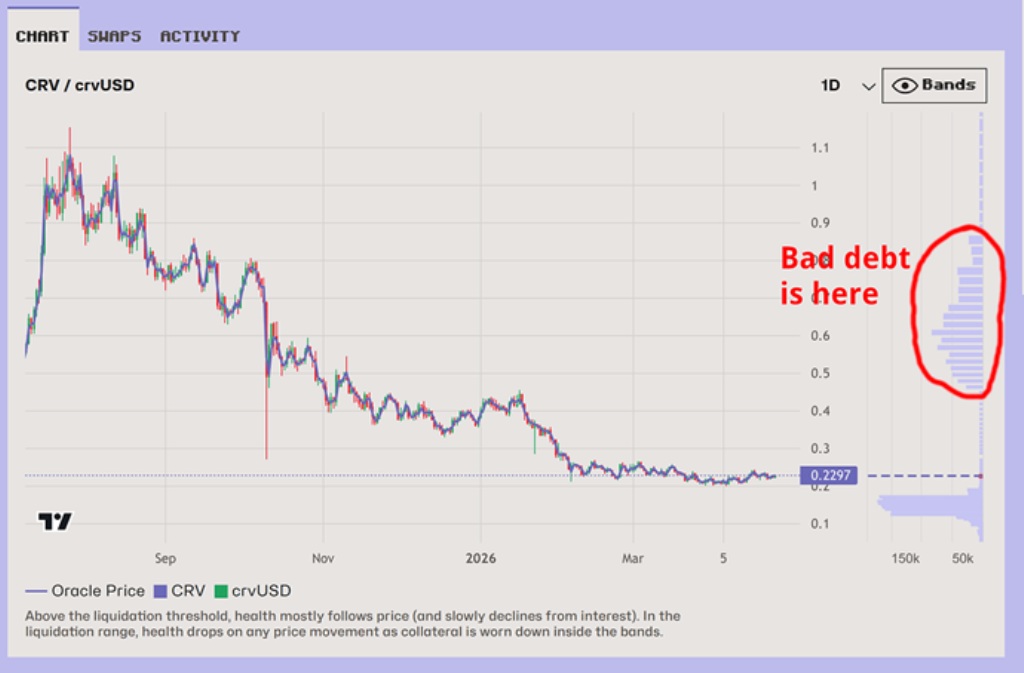
To make that instrument tradable, Egorov has already configured a stableswap pool on Curve anchored around 71% solvency, where deteriorated tokens can be exchanged. Liquidity providers could earn swap fees and, if governance approves it, Curve (CRV) incentives. The DAO itself could accumulate those tokens through admin fees without the need for a direct bailout vote.

The initial reaction was mixed. One user pointed out that nobody will buy positions that generate no immediate yield. Another replied that the instrument behaves more like a perpetual option at a discount with low downside exposure, and outlined three possible paths for any user: do nothing and wait for CRV to recover, sell at a discount now, or provide liquidity to the new pool and earn fees while waiting.
A more skeptical user questioned whether sophisticated capital would bother participating if the payoff profile can be replicated more cheaply elsewhere. The Curve founder responded that the appeal may lie in the stableswap LP itself, whose yield profile would be different and potentially more favorable than holding the vault token directly.





