Ethereum (ETH) is trading under pressure this week, hovering around $2,220–$2,260 as selling activity picks up on both spot and derivatives markets.
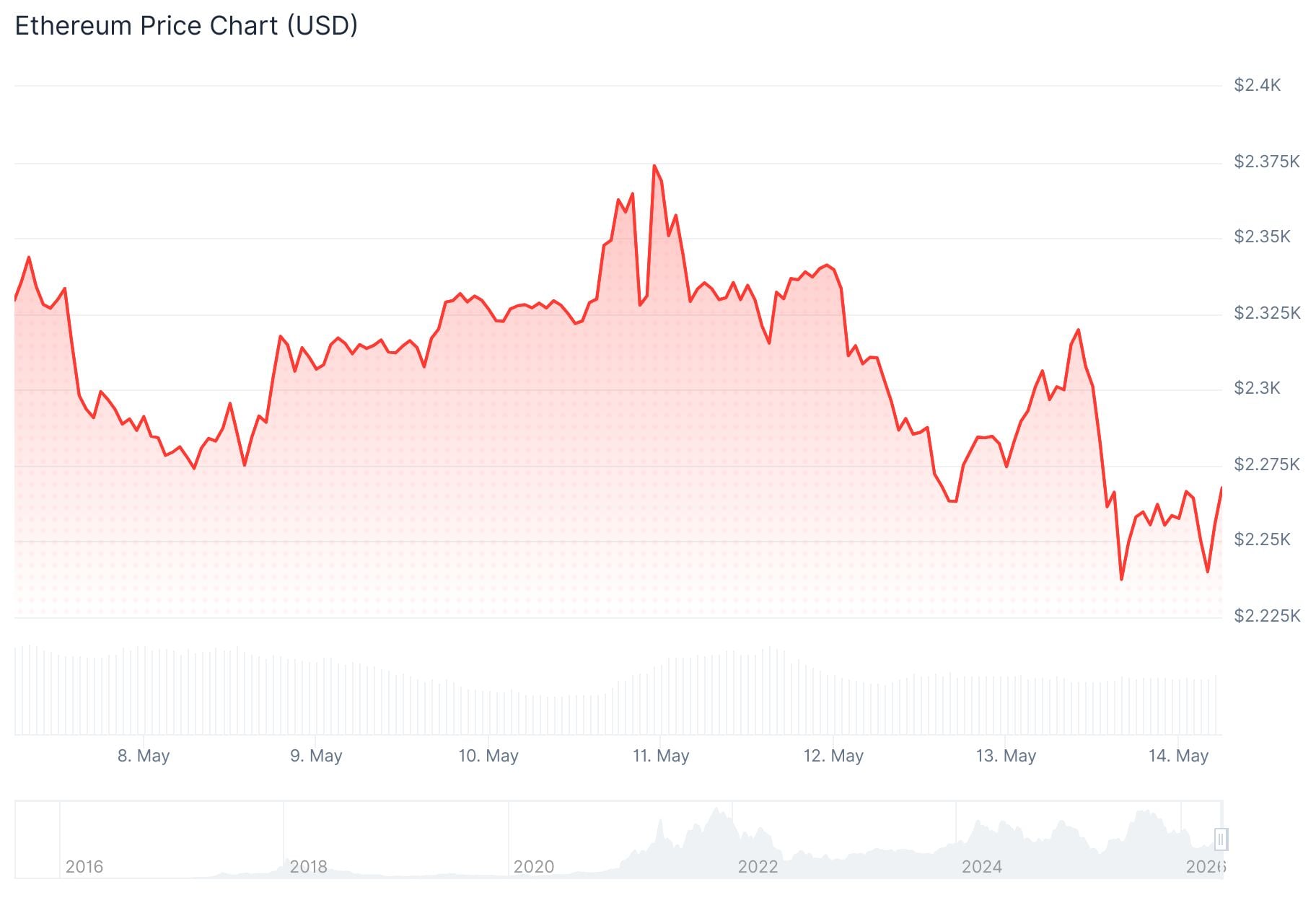
Exchange reserves across centralized platforms rose by 623,000 ETH between May 5 and May 13. That type of increase typically signals holders moving coins to exchanges in preparation to sell.
The selling is being led by larger wallets. Whales holding between 10,000 and 100,000 ETH reduced their collective balance by 390,000 ETH since May 7. According to on-chain data from CryptoQuant, that is the biggest weekly distribution from this group since late March.

Smaller holders in the 100–1,000 ETH range also kept selling, offloading around 110,000 ETH over the past week. Mid-tier wallets holding 1,000–10,000 ETH were the exception, actually adding 67,000 ETH during the same period.
US-based sentiment is notably weak. The Coinbase Premium Index, which compares ETH prices on Coinbase versus Binance, has been negative. Ethereum ETFs added to the gloom, recording $130.6 million in net outflows over two consecutive days per SoSoValue data.
Crypto analytics firm Santiment flagged an unusual on-chain signal this week. Despite ETH dropping roughly 5.5% over three days, the platform recorded the highest network realized profits in three weeks — a spike of $74.58 million.
Ethereum just registered its highest network realized profits in 3 weeks. This may seem counterintuitive to see a spike of $74.58M in realized profits while $ETH’s price has dropped ~5.5% over the past 3 days. But here’s why:
Holders with a much lower cost basis are… pic.twitter.com/YX6N6InkUX
— Santiment Intelligence (@SantimentData) May 14, 2026
Santiment analyst account @SantimentData explained the apparent contradiction. Holders who accumulated ETH during February and March — when it was trading below $2,000 — are still sitting on gains even after the recent dip. Many are choosing to take profits now while they still can, rather than waiting to see if prices fall further.
The firm noted elevated on-chain transaction volume, with 4-hour candles showing notable price compression around $2,241. More transactions mean more realized profit-and-loss events, which drives the network-wide total higher even when individual gains are modest.
Santiment advised traders to stay cautious but not necessarily turn bearish, watching for deeper realized losses as a potential signal that the distribution phase is ending.
On the technical side, Ethereum is currently below its 50-day EMA at $2,273, its 20-day EMA near $2,307, and its 100-day EMA around $2,352. These three moving averages form a combined resistance zone that has been capping recovery attempts.
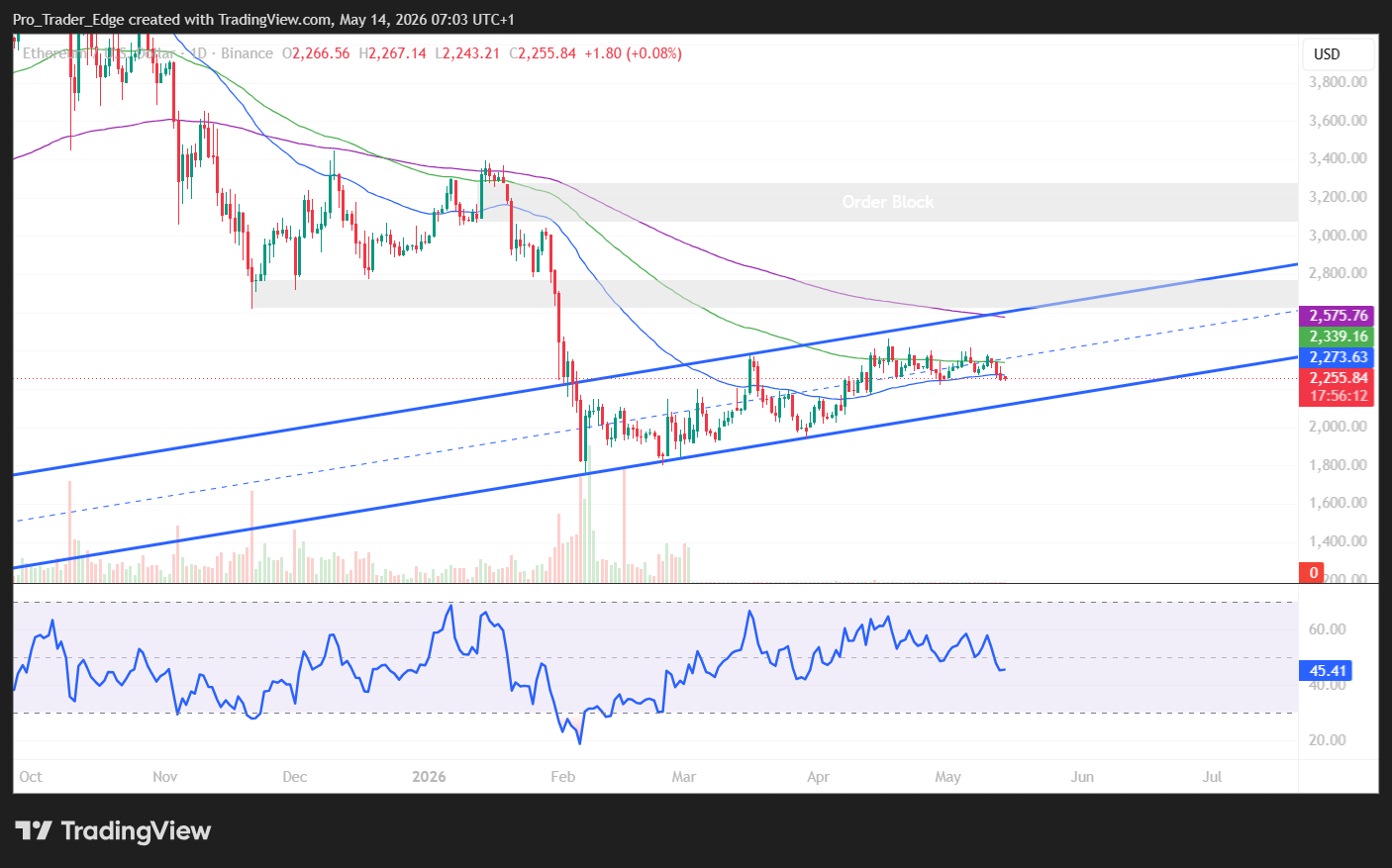
The Relative Strength Index sits near 45, and the Stochastic reading is around 12 — a deeply oversold level.
Key support sits at $2,211, with a more substantial floor around $2,107. If those levels break, analysts point to $1,909 and $1,741 as next demand zones.
Not everyone is bearish in the short term. ETH futures open interest rose to a record 15.5 million ETH, and funding rates have maintained a positive streak not seen since January, indicating traders are actively buying dips in the derivatives market.
ETH recorded $95.6 million in liquidations over the past 24 hours, with $84.3 million coming from long positions.
The post Ethereum (ETH) Price: Bears Have Control, but This On-Chain Signal Could Flip the Script appeared first on CoinCentral.





