European wholesale natural gas prices hovered near four-month highs on Friday, heading for a fourth consecutive week of gains.
The Dutch TTF front-month contract, Europe’s benchmark, rose 0.4%, while the equivalent British contract gained 0.3%. Gas prices have risen around 8% this week alone and have surged more than 42% in July.
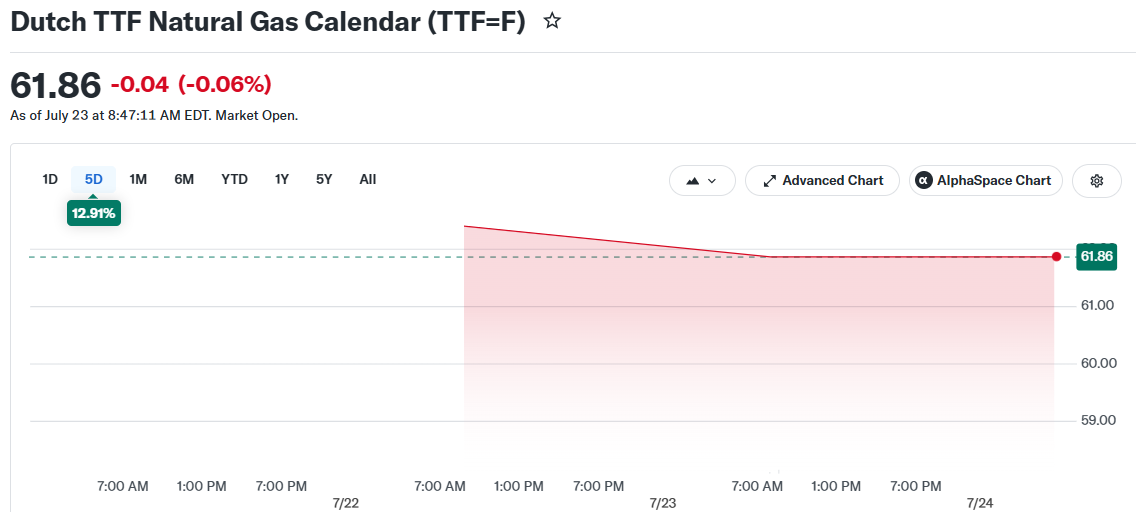
That four-week winning streak is the longest Europe has seen since May last year.
Equinor, Europe’s largest domestic gas supplier, issued a warning earlier this week that storage levels across the continent stand at roughly 54% capacity. That is below the five-year seasonal average and the second-lowest reading in 15 years.
The company’s chief executive said Europe is unlikely to reach its target of filling underground storage to 80% before the start of the heating season. That target exists to cushion supply shortfalls during cold months.
Low storage heading into winter leaves the market more exposed to sharp price swings if temperatures drop.
The United States carried out its 13th consecutive night of strikes on Iran this week. President Donald Trump warned Tehran and its Houthi allies in Yemen of further military action if attacks on Red Sea shipping continue.
🇾🇪 Insurance costs for shipping through the southern Red Sea doubled in a single day.
The jump came after Houthi forces hit at least one tanker overnight, with some companies now paying twice what they paid yesterday.
War risk premiums are the fastest signal in this whole… pic.twitter.com/w7OG07YfWT
— Mario Nawfal (@MarioNawfal) July 23, 2026
The conflict has disrupted tanker routes through the Strait of Hormuz, cutting off a portion of global LNG flows from the Persian Gulf.
With Persian Gulf supply reduced, Asian buyers have been outbidding European utilities for available LNG cargoes. That competition is pulling shipments away from European import terminals at a time when the continent can least afford it.
Hot weather across Europe has also pushed up electricity demand for cooling, adding further pressure to gas supply.
Rising energy costs are feeding into broader inflation pressures across Europe.
Money markets are increasingly pricing in the possibility that high fuel bills could delay further interest rate cuts. Central banks may need to hold tighter policy for longer if energy-driven inflation stays elevated.
The combination of supply disruption, weak storage, and strong demand is giving traders little reason to expect prices to ease soon.
The TTF contract remains near its highest level since March, and with no near-term resolution expected in the Middle East, the outlook for European consumers heading into autumn remains uncertain.
The post European Gas Prices Hit Four-Month High on Supply Fears and Middle East Conflict appeared first on CoinCentral.





