European natural gas prices surged on Monday, reaching levels not seen since late 2023. The benchmark Dutch front-month contract climbed to around €73.80 per megawatt-hour, just below last week’s peak of €74.32.
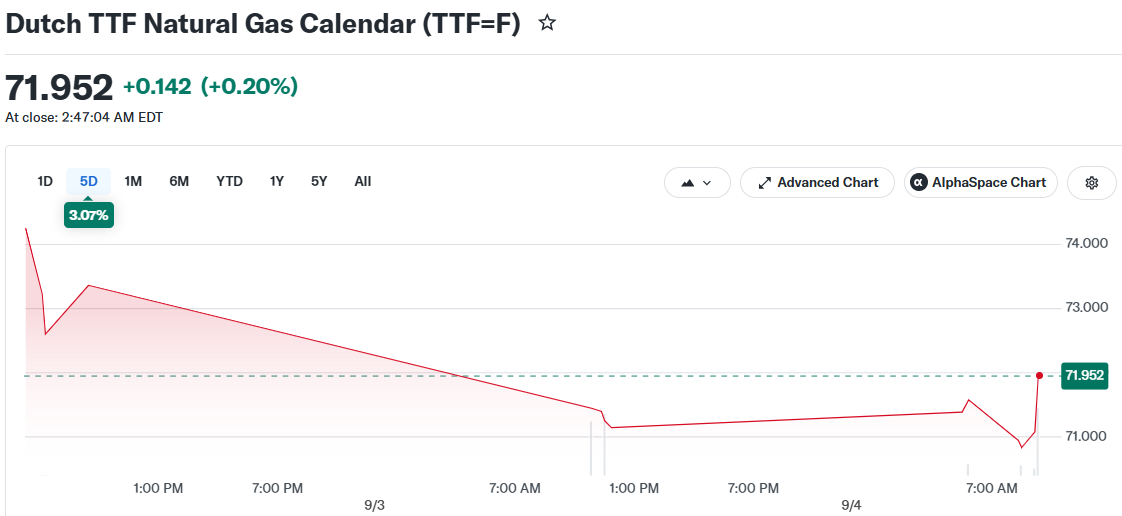
British wholesale gas prices also rose 2%, trading near 182.50 pence per therm, close to the 2023 high of 183.95 pence.
The gains come as military tensions between the US and Iran continue to escalate in the Persian Gulf.
Iran announced plans to declare a restricted maritime zone outside the Strait of Hormuz in the coming days. This follows US forces striking and disabling three Iranian oil tankers over the weekend.
BREAKING: Iran launches anti-ship ballistic missiles from Chabahar, southeastern Iran, toward vessels under US Navy escort in the US-backed southern Omani corridor of the Strait of Hormuz, per initial reports.
For the first time, the US Navy is escorting vessels during daylight,…
— The Hormuz Letter (@HormuzLetter) September 7, 2026
Washington said the strikes were in retaliation for Iranian ballistic missile attacks on two US Navy warships in the region.
The Strait of Hormuz carries roughly one-fifth of global liquefied natural gas traffic, most of it from Qatar. Any disruption to transit through the strait could cut off a key supply route to Europe.
European utilities are now competing against Asian buyers for available Atlantic basin LNG cargoes to cover the potential shortfall.
Traders are watching closely as the back-and-forth military exchanges show no sign of slowing down.
The conflict comes at a bad time for European energy markets. Storage facilities are only about 62% full, trailing the five-year seasonal average by around 17 percentage points.
A hot summer across Southern Europe pushed up gas-fired power demand. Maintenance work on Norwegian pipelines and delays to Qatari LNG deliveries also slowed the rate of storage refilling through August.
If LNG flows are disrupted this autumn, analysts warn Europe could face price spikes and possible supply rationing during cold winter periods.
Brent crude is also holding above $90 a barrel, adding more pressure to energy costs.
Rising energy prices are feeding into broader inflation in the eurozone. Headline inflation reached 3.3% in August, with energy costs up 14.3% year-on-year.
The European Central Bank meets on Thursday. Money markets have nearly fully priced in a 25 basis point rate hike from President Christine Lagarde.
Higher energy input costs are squeezing European industry and households, making the ECB’s policy choices harder.
The combination of low storage, supply risks, and rising inflation has European energy markets on edge heading into the colder months.
The post European Natural Gas Prices Hit Multi-Year Highs as US-Iran Tensions Escalate appeared first on CoinCentral.





