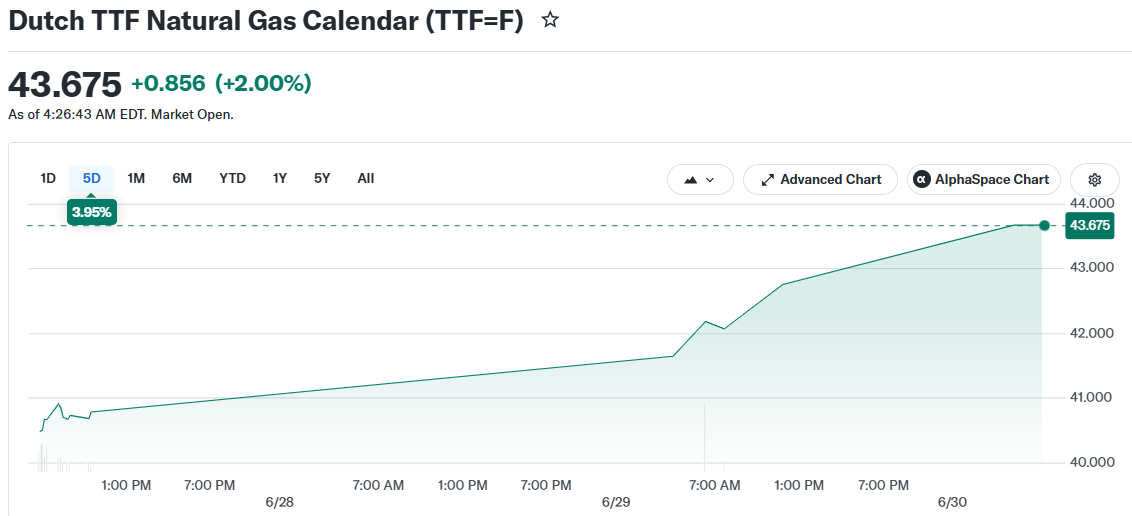
European wholesale natural gas prices climbed on Tuesday. Despite the daily gain, the market is still on pace for its first quarterly fall in more than a year.
The front-month Dutch TTF contract, the main European benchmark, rose 2% to 43.44 euros per megawatt-hour. That puts it on track for its first quarterly decline in six quarters.
Britain’s wholesale gas contract also gained 2%, reaching 104.57 pence per therm. It is heading toward its first quarterly drop in five quarters.
Prices spiked earlier this year during a military conflict involving Iran. The fighting raised fears about energy supply routes through the Middle East.
Attacks on ships last week briefly slowed traffic through the Strait of Hormuz again. The United States and Iran are scheduled to meet in Doha today for further talks.
The Strait of Hormuz carries about one-fifth of the world’s liquefied natural gas supplies. Any disruption there tends to push gas prices higher.
A ceasefire reached earlier this month allowed maritime traffic to resume more normally. Delayed LNG shipments from Qatar and the United Arab Emirates have started moving again toward international markets.
Global crude oil prices have also returned to levels seen before the conflict began. That removed some of the support that had been keeping European gas and electricity prices elevated.
Even with the broader price decline, traders say storage shortages could limit how far prices fall. European storage facilities are currently just under 48% full.
That is down from 56.2% during the same period last year. It also falls below the five-year average injection level of 61%.
A Financial Times report citing Wood Mackenzie said European Union storage may finish the refill season only about 76% full. That would mark the lowest peak storage level since at least 2011.
The shortfall stems from the Iran conflict, which blocked LNG shipments through the Strait of Hormuz. Reduced production in Qatar and the United Arab Emirates also played a role.
European storage sites started the injection season only 28% full. Average levels across Europe currently stand near 48%.
The European Commission said Sunday that current storage levels do not pose an immediate concern for energy security. It noted that filling storage to 80% is sufficient to cover winter needs.
A commission spokesman said storage is roughly 10% below pre-crisis averages. He added that gas demand across the EU has fallen about 17%.
The commission has recommended member states fill storage to at least 75% to 80%. In past years, the nonbinding target had been set at 90%.
The post Europe’s Gas Prices Are Finally Falling But Gas Storage Hits Lowest Level in 15 Years appeared first on CoinCentral.





