TL;DR:
Flare published a governance proposal that could make it one of the first layer-1 blockchains to capture maximum extractable value, known as MEV, directly at the protocol level. In most existing networks, that value flows toward a small group of specialized actors who benefit from transaction ordering at the expense of ordinary users, through practices such as front-running, sandwich attacks, and arbitrage.
MEV represents a considerable pool of revenue at a global scale: external estimates place annual figures in the tens of millions on networks like Arbitrum, over $500 million on Ethereum, and up to $1 billion on Solana. Flare’s proposal seeks to redirect those resources toward the FLR token’s own economy.
The plan contemplates a three-stage redesign of the block-building process. In the first stage, responsibility shifts from individual validators to a designated builder, initially operated by the Flare Entity. The second stage moves that process to Flare Confidential Compute, making it publicly auditable. In the third, builder and proposer merge into a single entity, while current validators take on a verification role.
To manage the captured revenue, the proposal creates the Flare Income Reinvestment Entity, known as FIRE. This entity would concentrate income from multiple protocol sources, including attestation fees, FAssets and Smart Accounts commissions, confidential compute charges, and captured MEV, with the primary mandate of reducing FLR supply through buybacks and burns on the open market.

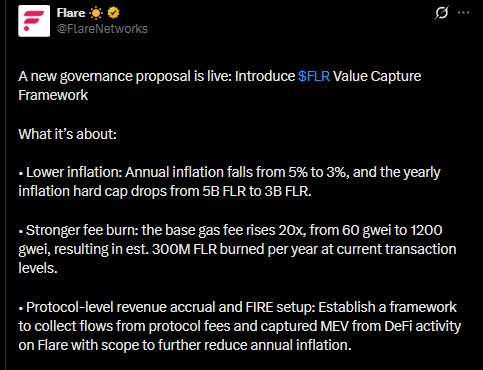
Several changes would take effect immediately upon approval. FLR’s annual inflation would drop from 5% to 3%, and the absolute emission ceiling would be cut from 5 billion to 3 billion tokens per year. The base gas fee would increase twentyfold, from 60 to 1,200 gwei, raising estimated annual burns from approximately 7.5 million to 300 million tokens at current transaction volumes. Even with that increase, a standard transaction on the network would cost a fraction of a cent.
Flare has deep roots in the XRP ecosystem: it distributed its initial token supply through an airdrop to XRP holders in 2023, and its FAssets system, which already holds over 150 million FXRP, is designed to bring smart contract functionality to assets on blockchains like XRPL that do not support it natively.





