TL;DR
Matt Hamilton, former Director of Developer Relations at Ripple Labs, has publicly defended the XRP Ledger (XRPL), emphasizing its blockchain features and cryptographic design similar to Bitcoin. During a debate with Bitcoin maximalists, Hamilton highlighted that XRPL groups transactions into blocks and links them using hashes, creating an immutable record just like BTC. He also mentioned that XRPL’s network efficiency allows faster transaction processing times compared to older networks, and it can handle higher throughput without compromising security, which is attracting growing developer interest and experimentation.
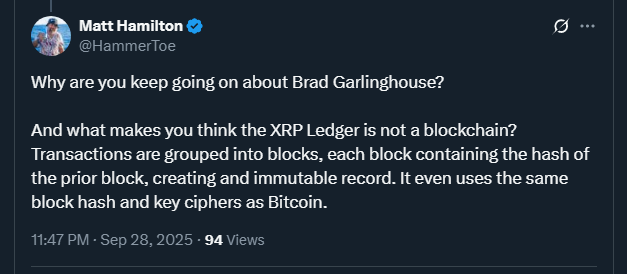
In discussions sparked by David Marcus, CEO of Lightspark and known Bitcoin supporter, Hamilton noted that while Bitcoin is widely regarded as immutable, newer networks like XRPL offer enhanced flexibility and efficiency. Marcus argued that such flexibility often sacrifices decentralization, reducing trustworthiness. Hamilton countered that XRPL remains highly decentralized because anyone can run a node, drawing a direct comparison to Bitcoin’s principles.
Hamilton also mentioned that Bitcoin’s mining landscape may change significantly after the upcoming halvings, potentially limiting miner participation. He suggested that XRPL’s approach ensures long-term sustainability and broader accessibility for users and validators, highlighting its reliability as a blockchain network. Moreover, Hamilton stressed that XRPL’s ledger design enables better integration with emerging financial applications, including stablecoins, cross-border payments, and programmable smart contracts, increasing its real-world utility.
The XRP Ledger has undergone key upgrades, including amendments like “fixAMMv1_3,” “fixEnforceNFTokenTrustlineV2,” and “fixPayChanCancelAfter,” showing a strong focus on network improvement. Validators were also urged to migrate settings to maintain functionality, ensuring the network continues operating smoothly.
Beyond technical updates, XRPL’s liquidity has seen a noticeable rise. Data from DeFiLlama shows XRP’s Total Value Locked (TVL) climbed from just over $90 million to $103.67 million, reflecting increased engagement from institutional holders. This trend suggests that major investors view XRPL as a dependable and cost-efficient blockchain, capable of supporting both large-scale transactions and DeFi applications.

Hamilton concluded that XRPL’s combination of decentralization, cryptographic security, and ongoing updates positions it as a competitive blockchain alternative, bridging traditional finance and emerging digital asset systems while remaining aligned with core principles observed in Bitcoin.





