Gold prices fell on Wednesday as new Middle East fighting dimmed hopes of a U.S.-Iran peace deal, while traders waited on key U.S. jobs data for clues on interest rates.
Spot gold slipped 1.0% to $4,444.86 an ounce. Gold futures also fell 1.0% to $4,475.62 an ounce by early Wednesday morning.
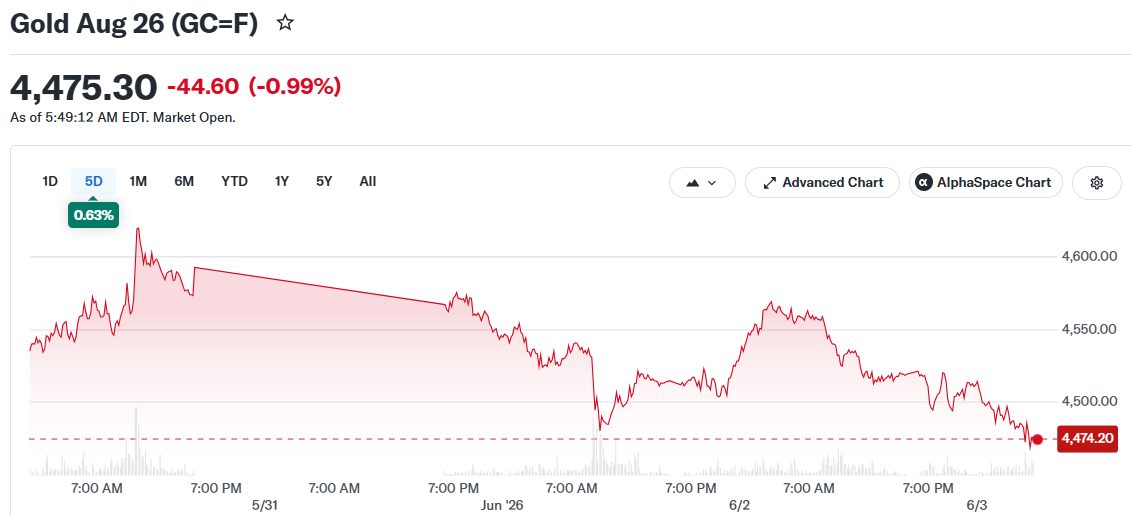
The drop came after the U.S. military reported that Iranian forces launched air attacks on Kuwait, Bahrain, and other targets. The U.S. said the attacks were repelled or failed.
Iranian state media, however, claimed that the Islamic Revolutionary Guard Corps struck the U.S. Fifth Fleet headquarters in Bahrain. Iran said this was retaliation for a U.S. strike on a communications tower near Qeshm.
BREAKING: Iran has launched a massive ballistic missile and drone attack, striking the US 5th Fleet headquarters in Bahrain along with US bases in Kuwait, Ali Al Salem + Arifjan, and an oil tanker near Dubai, in response to new US strikes on Qeshm Island and an Iranian oil tanker…
— The Hormuz Letter (@HormuzLetter) June 3, 2026
President Trump said talks between Washington and Tehran are still ongoing. But the fresh fighting made markets less confident a deal is close.
Brent crude futures rose on the back of the conflict. Traders are worried that a deal to reopen the Strait of Hormuz — a key shipping lane for around a fifth of the world’s oil — is now less likely.
Higher oil prices raise concerns about inflation. If inflation picks up, central banks may be forced to raise interest rates.
Markets currently expect the Federal Reserve to hold rates steady at its June meeting. But traders are still pricing in the possibility of a hike later this year.
Gold, which pays no yield, tends to perform poorly when interest rates are high or rising.
The U.S. dollar also strengthened, which can make gold more expensive for buyers using other currencies. Investors have moved toward the dollar during the Iran conflict, partly because the U.S. is a major energy exporter.
Data released Tuesday showed U.S. job openings rose unexpectedly in April. That reinforced the view that the Fed may keep policy tight for longer.
Traders are now watching several data releases due Wednesday, including the ADP private employment report, the ISM services survey, and factory orders figures.
All of this comes before Friday’s nonfarm payrolls report, which is closely followed by markets.
Simon-Peter Massabni of XS.com said investors appear to be avoiding large new positions ahead of that release. “Without a clear signal from the data, gold is likely to continue trading in a consolidative pattern,” he said.
Neil Walsh, Head of Metals at Britannia Global Markets, noted that “the market remained cautiously watchful regarding U.S.-Iran negotiations.”
Gold has been trading below the $4,500 level as uncertainty keeps buyers on the sidelines.
The post Gold Falls Below $4,500 as Middle East Tensions Rise and U.S. Jobs Data Looms appeared first on CoinCentral.





