Gold prices steadied slightly on Friday after three straight weeks of losses. Spot gold was up 0.3% to $4,036.88 an ounce, while U.S. Gold Futures added 0.1% to $4,051.30. Despite the small bounce, gold is still on track for a nearly 3% weekly loss.
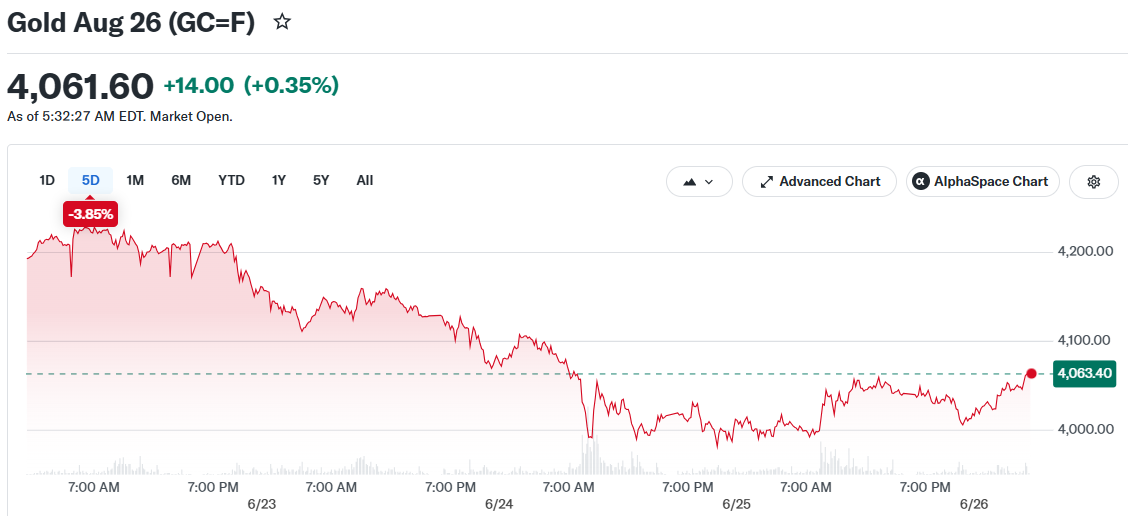
The metal has fallen roughly 11% this month. That decline is tied directly to a stronger U.S. dollar and growing bets that the Federal Reserve will raise interest rates again.
The U.S. dollar held near a 13-month high on Friday. It was heading for a second straight weekly gain. A stronger dollar makes gold more expensive for buyers using other currencies, which tends to reduce demand.
When interest rates rise, gold becomes less attractive to investors because it pays no yield. With rates potentially heading higher, some investors have been moving money elsewhere.
Thursday’s personal consumption expenditures data added to the pressure on gold. The PCE price index rose 4.1% in May from a year earlier. That is the highest reading in more than three years and the first time it has topped 4% since 2023.
First, PCE inflation is now officially up to 4.1%, the highest since April 2023.
Inflation is more than double the Fed's 2.0% target, and PCE is the Fed's preferred metric.
But, this news did NOT drive markets lower today.
In fact, futures were higher after the data. pic.twitter.com/IjnyJn5GZP
— The Kobeissi Letter (@KobeissiLetter) June 25, 2026
The PCE index is the Fed’s preferred measure of inflation. A reading that high gives the central bank more reason to keep tightening policy.
Markets now see a 63% chance of a Fed rate hike by September, according to the CME FedWatch tool. That expectation has been a key driver of gold’s recent weakness.
Analysts at Saxo Bank noted that gold is heading for a fourth weekly loss. They said investor sentiment remains shaken by the recent selloff as markets adjust to a hawkish Fed and a stronger dollar.
However, Saxo Bank also pointed out that falling energy prices and softer bond yields could eventually reduce pressure on the Fed to keep tightening. That could offer some support to gold down the road.
A reported attack on a cargo vessel near the Strait of Hormuz briefly lifted gold. The incident revived some safe-haven demand, as the region remains tense despite a preliminary U.S.-Iran peace agreement.
The support from that event was short-lived. Dollar strength and rate hike expectations continued to outweigh geopolitical concerns.
Other precious metals also struggled. Silver edged up 0.1% to $57.96 per ounce but was still heading for a 12% weekly drop. Platinum rose 1% to $1,618.23 per ounce, though it remains on track for a seventh consecutive weekly loss.
Copper also fell. London Metal Exchange Copper Futures dropped 0.4% to $13,249.33 a ton. U.S. Copper Futures slid 0.2% to $6.06 a pound.
Gold was last trading near $4,053 per ounce in early Friday trade, still down nearly 5% on the week.
The post Gold Is Down 11% This Month — And It Could Get Worse Before It Gets Better appeared first on CoinCentral.





