TL;DR:
Hedera introduced Agent Lab, a fully integrated development environment accessible from the Hedera Developer Portal. The tool is built on the open-source Agent Kit and aims to reduce the complexity that developers have historically faced when attempting to connect artificial intelligence agents with a blockchain network.
Until now, that process involved environment configuration, framework decisions, boilerplate code and a testing infrastructure that demanded significant time before producing any functional result. Agent Lab condenses those steps into a flow that, according to the Hedera team, allows going from zero to an operational agent in a matter of minutes.
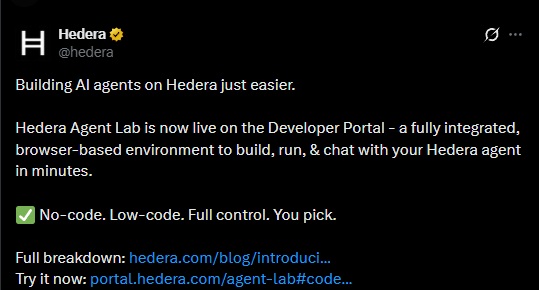
The platform offers three working modes. The first is a no-code Agent Builder that guides the user through preconfigured templates for use cases within the Hedera ecosystem, ranging from basic transactions to an agent with full access to all available tools. The second is a low-code mode where the developer selects a framework and plugins while watching the source code being built in real time. The third is an advanced mode with direct code editing and assistance from an AI-powered integrated editor.
Regarding the framework, users can choose between LangChain or the Vercel AI SDK, while support for Google ADK is planned for upcoming versions. Each selection immediately impacts the generated code, making it easy to compare approaches or stay within one already familiar.

The execution mode is especially relevant for those operating with real assets. The Human-in-the-Loop option forces the agent to present the unsigned transaction bytes before any operation reaches the network, requiring explicit approval from the user. The autonomous mode, on the other hand, executes transactions without intervention and is primarily intended for testing environments on the Hedera Testnet.
The team also announced the upcoming addition of Policies and Hooks, a system of deterministic code-level controls that will operate independently from the AI model. Configurable restrictions include maximum HBAR limits per transaction, lists of permitted tokens and constraints on the creation of tokens with unlimited supply.





