TL;DR
Houdini Swap rolled out a service that places privacy at the center of crypto payments and aims to solve a recurring problem for freelancers: every time they share a public address, they expose their entire transaction history, the services they interact with, and the exact amount they hold in their wallets.
Houdini Pay tries to close that gap with a setup that hides the on-chain link between payer and recipient without relying on mixers or complex cryptographic mechanisms.
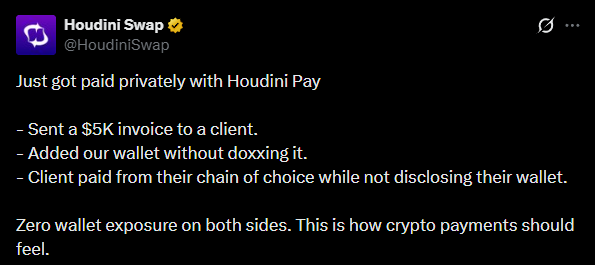
The system lets users create a fixed, shareable payment link that supports more than 4,000 assets across multiple blockchains. The payer sends whatever asset they choose, and the service converts it into the asset preferred by the recipient. That internal routing removes the direct relationship between both addresses. Fees are paid by the sender, and the recipient gets the full amount, with no link-expiration limits. The structure is simple: it doesn’t let users edit the amount and it doesn’t offer strong cryptographic privacy, but it does prevent either party from accessing the other’s balance or transaction history.
Houdini Pay operates as a centralized service that adheres to AML standards, applies geoblocking, and stores basic metadata such as involved wallets, amounts, assets sent, and even IP addresses. The company notes that if a transaction raises red flags, intermediaries may request additional information. CEO Joshua Rogers stresses that the product is not a mixer and does not custody crypto; he describes it as privacy infrastructure aligned with current regulations.

Comparisons with full-privacy models are inevitable. Tools like zkBob use zero-knowledge proofs to hide sender, recipient, and amounts at the protocol level, but limit support to a small set of assets. Houdini Pay takes the opposite approach: broad operational coverage and low friction, even if the anonymity level is lower.
Houdini’s goals are highly concrete. There have been cases where clients renegotiate fees after checking a freelancer’s balance, or where competitors replicate business strategies by identifying payments to suppliers. That exposure comes with a growing physical threat. So-called $5 wrench attacks and kidnapping attempts have become a dangerous trend that needs immediate attention





