TL;DR:
Hyperliquid launched its canonical prediction markets for off-chain events, strengthening its position beyond perpetual futures. The platform announced the launch through its Telegram channel, detailing that the markets are built on the HIP-4 standard and use Circle’s USDC as the quote asset. The first available instruments will be tied to the year-over-year change in the May Consumer Price Index and to the June federal funds rate decision.
The operating mechanism falls on the validators, who run automated news software to publish markets and vote on both the deployment and settlement of each event. The integration within the existing trading stack allows users to trade on event outcomes alongside spot and perpetual futures positions, with no need to move collateral to a separate platform.

This launch reinforces the thesis that analytics firm Delphi Digital anticipated in a December report: Hyperliquid is evolving from a perpetuals DEX into an onchain financial venue. “What is different now is that the stack is finally mature enough for true crypto superapps to exist without being confined to the wallet format,” Delphi noted in that document.
Matt Hougan, Chief Investment Officer at Bitwise, elaborated on the same point recently. He described Hyperliquid as the superapp that former SEC Chairman Paul Atkins had envisioned: a platform unregulated by the SEC that offers exposure to multiple asset classes. Hougan characterized the HYPE token as “one of the most undervalued assets in crypto today“, arguing that investors price it solely as a perpetuals DEX rather than as comprehensive financial infrastructure.
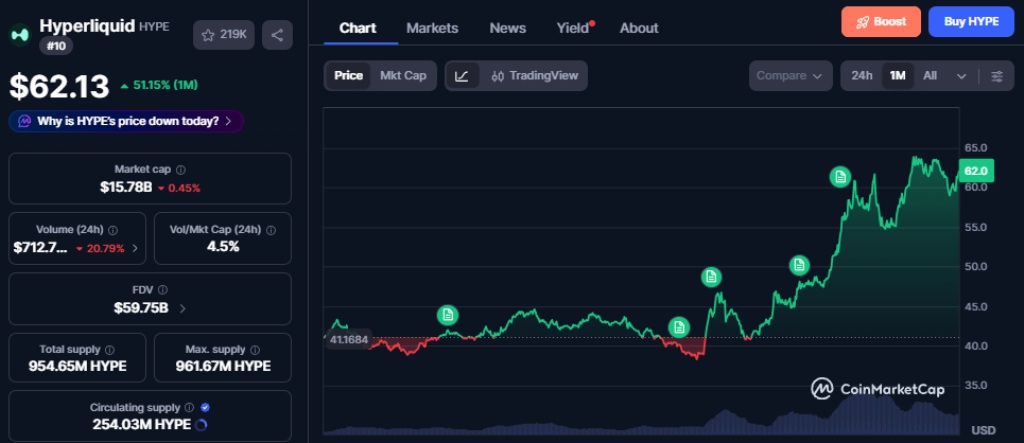
According to DefiLlama, Hyperliquid is currently the fifth protocol by weekly fees, having generated over $11 million in the past week. Last month the platform received $50.95 million in revenue, all of which was distributed directly to token holders with no resources allocated to incentives. The price of HYPE had already priced in part of this move: it rose 20% when Hyperliquid first announced its plans to incorporate prediction markets.





