Intel Stock fell to $103.12 on July 13 as semiconductor weakness and new spending plans pressured market sentiment. The decline followed a wider chip-sector selloff and renewed concerns about Intel’s near-term profit margins. Intel Stock now faces a crucial test as technical weakness meets a planned $5.7 billion artificial intelligence investment.
Intel Stock traded below its 20-day exponential moving average of $118.36 and its 50-day average of $110.61. The shares also closed at the lower daily Bollinger Band, which stood at $103.12. That position showed strong selling pressure, while the Bollinger midline remained far higher at $123.88.
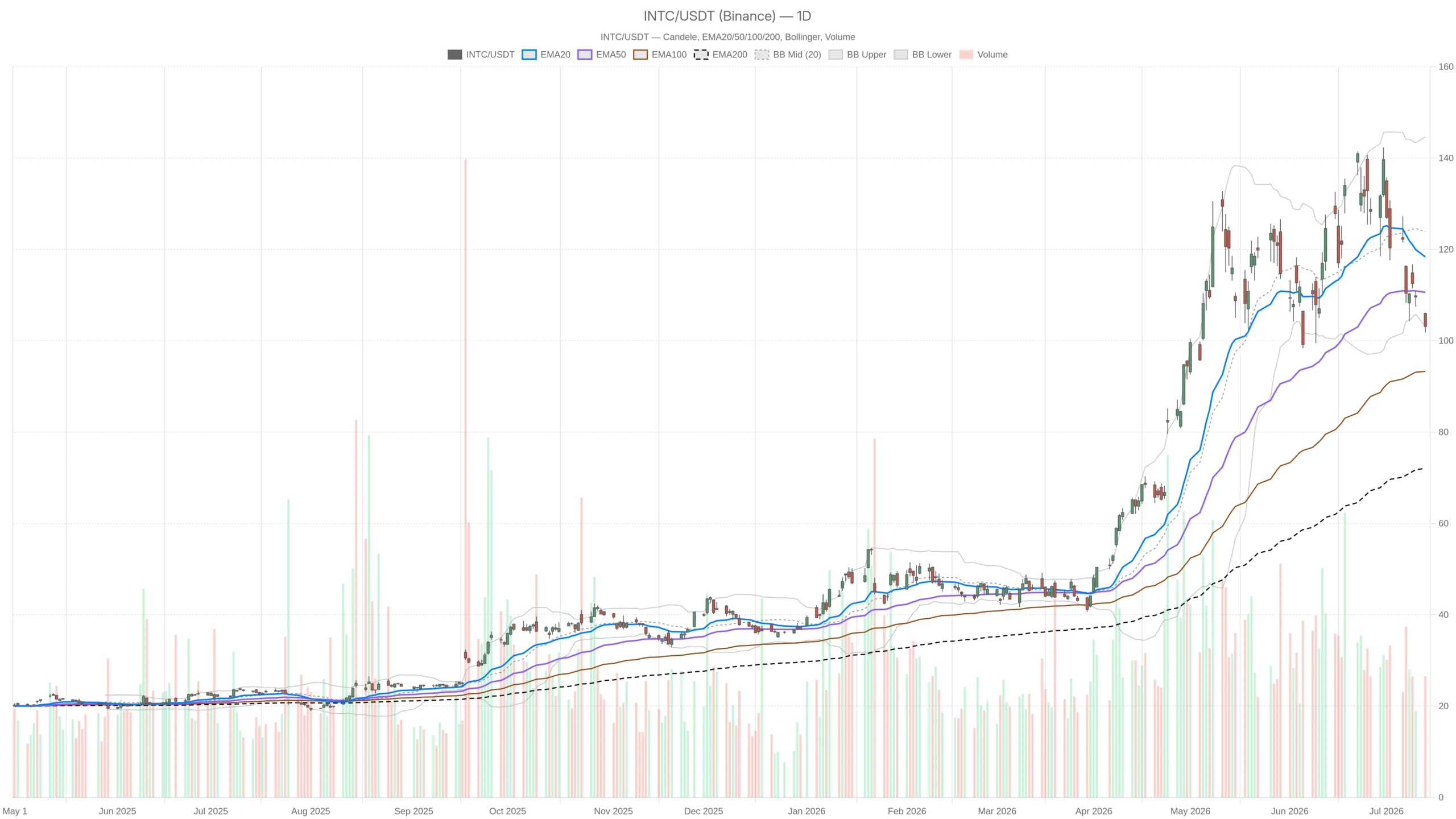
The daily relative strength index reached 39.4, approaching oversold territory without confirming a reversal. Meanwhile, the moving average convergence divergence line stood at negative 1.38, below its 2.26 signal. Its negative 3.64 histogram showed that bearish momentum continued to accelerate during the latest session.
Intel Stock also closed below the daily pivot of $103.69, weakening its short-term technical position. Initial resistance stood at $105.60, while daily support appeared near $101.22. A break below that support could expose the psychological $100 level during another volatile session.
The hourly chart kept Intel Stock below all three major exponential moving averages. Its 20-hour average stood at $107.25, while the 50-hour and 200-hour averages remained considerably higher. This bearish alignment showed continued distribution across both daily and hourly timeframes.
However, the hourly relative strength index fell to 30.26, indicating that selling had reached stretched levels. The hourly MACD histogram narrowed to negative 0.42, showing that downward momentum had started slowing. Price remained near $103.08, with nearby hourly support at $102.18 and resistance at $103.79.
The 15-minute chart showed only a modest improvement in buying activity during late trading. Intel Stock remained below its 15-minute EMA20 of $103.57 and EMA50 of $105.90. Although the MACD histogram turned slightly positive, the broader technical structure stayed firmly bearish.
Intel announced plans to spend $5.7 billion supporting its artificial intelligence strategy and related expansion. The commitment highlighted Intel’s long-term technology goals, but it also increased near-term margin concerns. Intel Stock weakened as markets assessed whether future growth could offset higher development and infrastructure costs.
The decline also followed pressure across semiconductor companies after negative developments involving South Korean chipmakers. Intel, AMD, and Applied Materials each fell roughly 4% as selling spread across global technology markets. Higher oil prices added another source of uncertainty and increased pressure on risk-sensitive shares.
Intel Stock may face further volatility before the company releases its next quarterly financial results. A recovery would require the shares to regain $103.69, then challenge resistance near $105.60 and $110.61. Intel Stock ended at $103.12, with bearish momentum and margin concerns still shaping the latest market outlook.
The post Intel Stock Hits $103 During Chip Rout and Spending Concerns appeared first on CoinCentral.





