TL;DR:
Kaia Investment Partners (KIP) is the new subsidiary of the Kaia DLT Foundation, headquartered in Singapore, designed to act as the institutional investment and incubation arm of the firm’s ecosystem. Its goal is to deploy external capital —not treasury funds or native tokens— to generate real value on-chain, increase Total Value Locked (TVL), and connect traditional finance with the network’s blockchain infrastructure.
The decision to fund KIP exclusively with external LP capital represents a structural shift from the previous model, which relied on the organization’s own treasury. Under a Variable Capital Company (VCC) structure in Singapore, KIP formally separates external risk capital from the ecosystem’s internal funds, providing the legal and operational framework demanded by major liquidity providers and international financial institutions.
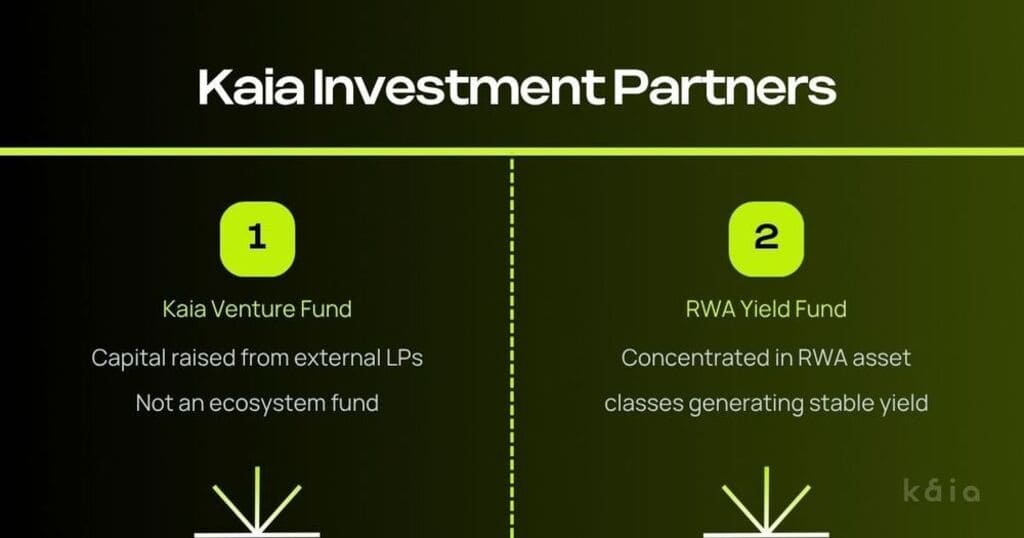
KIP operates through two divisions. The first is the Venture Capital Division, which will launch the Stablecoin Mass Adoption Venture Fund I in co-ownership with Simsan Ventures, a firm with deep-tech expertise and a presence in Europe, the Middle East, and Asia. The fund will allocate 70% of its capital to Asian markets and the remaining 30% to global markets, focusing on payments infrastructure, yield protocols, and regulatory compliance solutions. Kaia’s differential advantage lies in its direct access to more than 250 million users through the LINE and Kakao super-apps.
The second is the RWA Division, which manages the Kaia Multi-Asset Yield Fund. Its objective is to transform fragmented regional private credit into tokenized products accessible to investors worldwide, under a scheme similar to that of ETFs. The strategy will begin with dollar-denominated assets and stablecoins, and could subsequently expand toward local currencies such as the Korean won, the Japanese yen, and the Indonesian rupiah.

The RWA division integrates three tokenization mechanisms: proprietary funds that aggregate diversified yield assets, the incorporation of tokens issued by ecosystem partners such as Morpho, OpenEden, and Hann Finance, and the direct tokenization of individual high-yield assets in private credit and physical infrastructure. Among the projects is the tokenization of Hong Kong floating rate bonds.
The first product under this framework is Yield-8, a tokenized fund designed to deliver stable returns backed by real-world assets. The integration of Yield-8 with SuperEarn, the ecosystem’s yield distribution layer, will be detailed in an upcoming official update from the Foundation.





