Maersk beat first-quarter earnings estimates on Thursday but its stock dropped sharply as investors focused on what comes next — and the picture isn’t pretty.
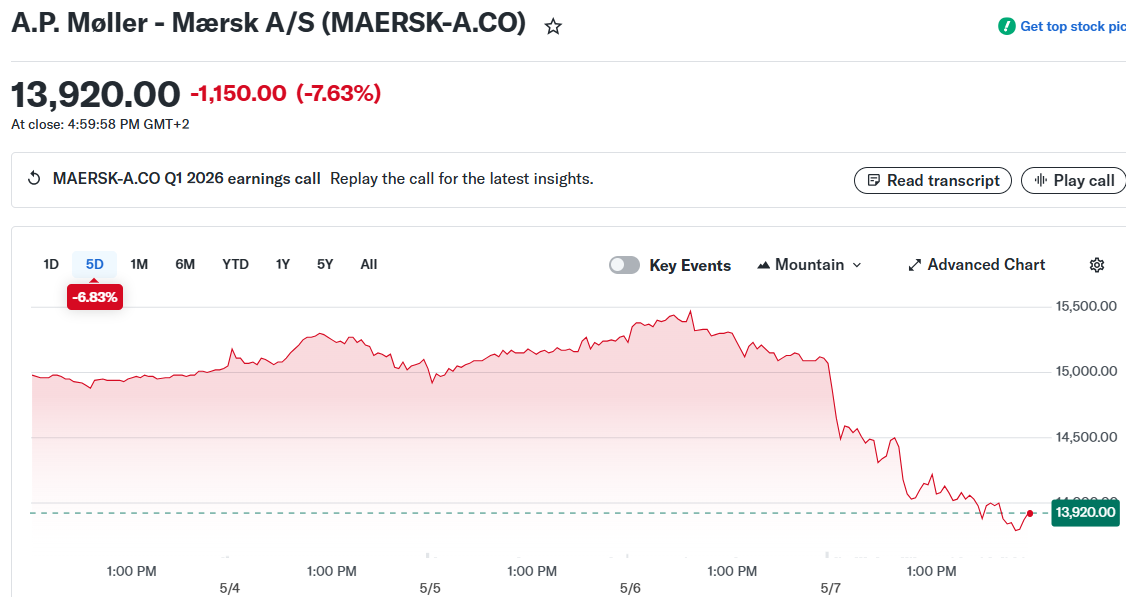
The Danish shipping giant reported Q1 EBITDA of $1.73bn, ahead of the $1.66bn analyst consensus. But that figure was a steep drop from the $2.71bn posted in the same period last year.
The stock fell 7.5% in Copenhagen trading, underperforming a broadly flat benchmark index.
Freight rates declined through most of the quarter due to ongoing capacity oversupply. They only rebounded sharply toward the very end of the period, after the Iran conflict escalated in late February.
The war began on February 28, when the US and Israel launched coordinated strikes on Iran. That means Q1 results don’t yet fully reflect the conflict’s impact on global supply chains.
Iran’s decision to close the Strait of Hormuz to commercial traffic has forced vessels to reroute, pushing up fuel costs and disrupting established shipping lanes across the industry.
Maersk is now rerouting ships around Africa, away from the Suez Canal and the Bab el-Mandeb Strait. That marks a reversal of earlier plans to gradually return some services to the Suez route.
CEO Vincent Clerc was blunt about the energy situation. “The energy crisis does not go away the day peace comes,” he told reporters, adding that oil companies expect elevated costs to last “at minimum several more months.”
Maersk kept its full-year guidance unchanged, maintaining its forecast for global container volume growth of 2% to 4%. But it warned conditions remain volatile.
The company flagged that higher energy prices and trade constraints in the Upper Gulf — which accounted for around 6% of global container trade in 2025 — pose downside risks to that growth forecast.
Morgan Stanley analysts said they see “limited scope for earnings upgrades” from the update, with any revisions likely to track freight rate movements.
They noted that rates on major European lanes have nearly reversed all gains recorded since the start of the Iran conflict. New vessel supply continues to outpace demand — Maersk alone ordered eight ships in February.
Jyske Bank analyst Haider Anjum warned of a possible earnings cut later in the year. “Freight rate developments are not expected to be able to compensate for the higher fuel costs,” he wrote.
Morgan Stanley flagged one potential upside: bunker fuel shortages, which could drive faster idling of vessels. They noted this isn’t visible in the data yet, but said it’s worth monitoring.
Maersk said it is working to pass higher costs on to customers, though how successful that effort will be remains to be seen given current rate trends.
The Asia-Europe freight rate has nearly returned to pre-war levels, even as fuel costs stay elevated — a combination that analysts say could squeeze margins in the quarters ahead.
The post Maersk Stock Drops After Q1 Earnings as Iran War Clouds Outlook appeared first on CoinCentral.





