TL;DR:
Matt Hougan, Chief Investment Officer at Bitwise Asset Management, published a memo addressed to clients in which he argues that cryptocurrencies could be structurally undervalued. The reason, according to Hougan, is not technical but behavioral: anchoring bias leads investors to keep reading the market through obsolete conceptual frameworks, shaped during the Silk Road scandal in 2013 or the Mt. Gox collapse in 2014.
“There is a large gap between what investors think is happening in the crypto world and what is actually happening,” Hougan wrote. He argues that this perceptual distortion prevents recognition of the structural changes underway, and that the opportunity lies precisely there.

The memo details a series of institutional moves that, according to Hougan, demonstrate that traditional finance is migrating toward blockchain infrastructure at a pace the market has yet to reflect. Larry Fink, CEO of BlackRock, declared in October that markets are “at the beginning of the tokenization of all assets.” Weeks later, BlackRock launched its tokenized Treasury bond fund BUIDL on Uniswap, which already surpasses $2 billion in assets, and invested in the platform’s native token UNI.
Apollo, the credit manager with $700 billion in its portfolio, tokenized its Diversified Credit Fund across six different blockchains and announced the acquisition of a 9% stake in Morpho, one of the leading decentralized crypto lending protocols. JPMorgan launched a deposit token on Coinbase‘s Base network, Ethereum’s layer 2. In addition, JPMorgan, Bank of America, Citigroup and Wells Fargo are exploring the joint launch of a stablecoin.
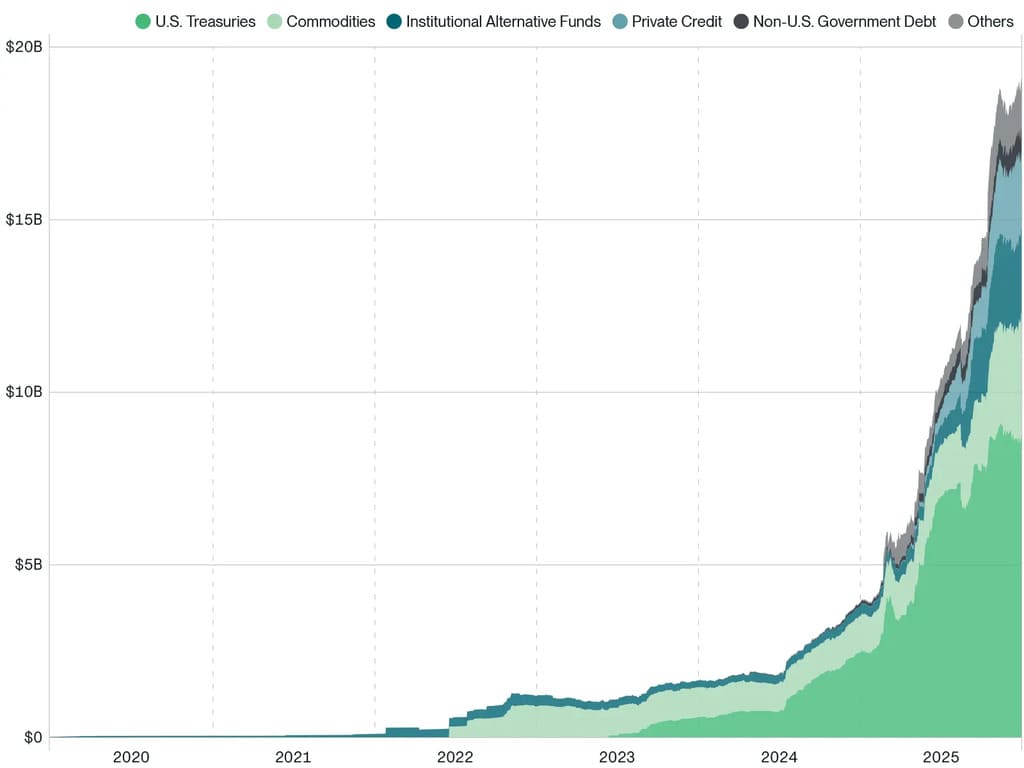
To contextualize the potential magnitude of these developments, Hougan contrasts the figures: ETFs manage close to $30 trillion, equities represent $110 trillion and bonds $145 trillion. The total tokenization market barely reaches $20 billion, implying a growth runway of up to 10,000 times if tokenization becomes widespread.
Even so, Hougan acknowledges that open questions remain: whether the value of tokenization will accrue to public networks like Ethereum or Solana, whether quasi-private chains like Canton Network will capture that role, and whether the beneficiaries will be crypto-native protocols or incumbent financial players. “The honest answer to most of these questions is: nobody knows yet,” he wrote. Nevertheless, he concludes that building positions across the breadth of the sector before the crypto market corrects its perception represents the greatest available source of alpha today.