Nvidia Corporation (NASDAQ: NVDA) ended Friday at $173.72, down 2.33%, as the market reacted to a Trump executive order hiking tariffs on Canadian goods from 25% to 35%, effective August 7.
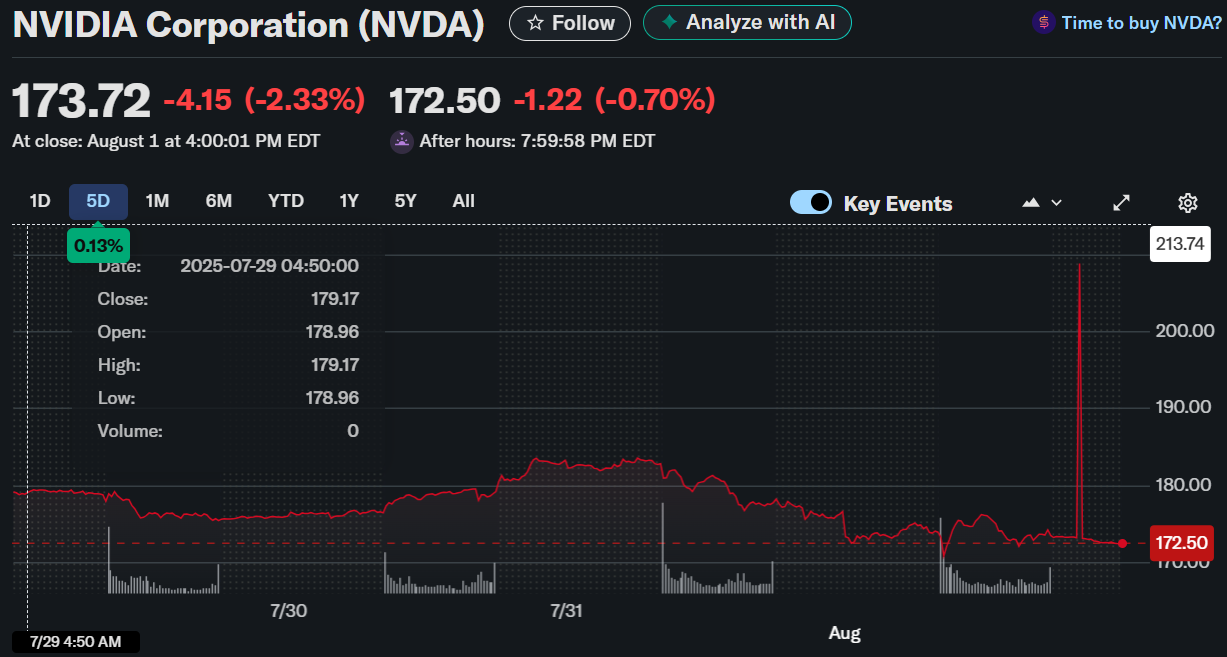
The decline comes despite earlier highs of $183.30 reached after resumed U.S.-China trade talks and hopeful comments from Treasury Secretary Scott Bessent. President Trump’s AI policy initiatives and global chip tensions continue to influence Nvidia’s volatile stock action.
Nvidia recently secured U.S. government approval to sell its H20 AI chips in China. Reuters reported Nvidia ordered 300,000 more chips from Taiwan Semiconductor, supplementing a stockpile of up to 700,000 units. In 2024, it sold roughly 1 million H20 chips. The move follows accusations from Chinese regulators about U.S. lawmakers seeking local AI tracking capabilities, claims Nvidia has denied.
Big Tech’s capital expenditure plans appear poised to benefit Nvidia. Amazon disclosed a $60 billion second-half 2025 spending plan, with a sizable portion allocated to Nvidia chips. Meta forecasts $68 billion in full-year spending, while Microsoft expects to invest over $30 billion this quarter. Alphabet recently raised its 2025 outlook to $85 billion. These massive outlays underscore Nvidia’s pivotal role in AI infrastructure.
In Q1, Nvidia reported earnings per share of $0.81, a 33% year-over-year rise, with revenue surging 69% to $44.1 billion. While below Wall Street’s projected $0.88 EPS, sales exceeded estimates. Despite Huawei testing a competing AI chip, Nvidia leads with a top-tier EPS Rating of 99 and Composite Rating of 99. The company also became the first to hit a $4 trillion market cap.
Morgan Stanley raised its price target to $200, while Citi lifted theirs to $190. Loop Capital’s bullish $250 forecast implies a $6 trillion valuation. Mizuho now expects 5.3 million AI accelerators to ship in 2025, rising to 6 million in 2026. Analyst Vijay Rakesh noted the upcoming Rubin server, 3.3x faster than Blackwell Ultra, could unlock broader data center market access if Nvidia transitions to air cooling.
Nvidia is actively growing its AI footprint in Europe and the Middle East. It’s partnering with Deutsche Telekom on an industrial AI cloud and engaging with U.K. and Saudi Arabian partners. The collaboration with Saudi Arabia’s Humain, backed by the Public Investment Fund, underlines Nvidia’s global strategy.
Nvidia’s stock has outperformed the S&P 500 significantly, with a five-year return of over 1,540% versus the S&P’s 90.7%. Funds own 40% of outstanding shares, and Nvidia remains a top pick on IBD’s Leaderboard and IBD 50 growth stock list.
The post Nvidia Corporation ($NVDA) Stock: Tumbles After Trump’s New Tariff – Is This a Buying Opportunity or a Warning? appeared first on CoinCentral.





