TL;DR
Optimism published a technical document positioning its infrastructure as the foundation for stablecoin products and tokenization aimed at financial institutions.
The document identifies two deployment models on the OP Stack: OP Mainnet, Ethereum’s public Layer 2 network connected to dollar liquidity, and a dedicated OP Enterprise chain that adds capacity, custom configuration and controls at the sequencer level.
The central argument of the document is that the choice of infrastructure must stem from each business’s requirements, not from comparisons between protocols. Three questions are key to this decision: where dollar liquidity resides, where compliance controls are applied and who operates the chain.
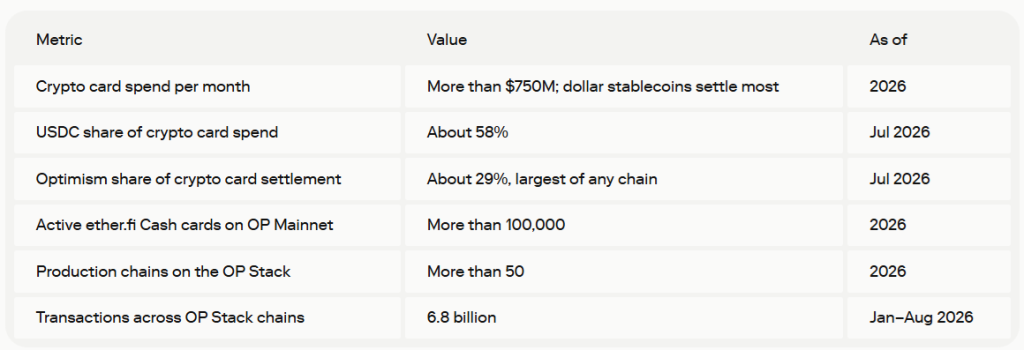
OP Mainnet addresses the first point, connecting an Ethereum-aligned network where USDC and USDT already operate with significant volume. The dedicated OP Enterprise chain addresses the second and third, offering control over transaction economics, permissioned access and integration of screening providers such as TRM, Blockaid and Forta.
Market data accompanies Optimism’s documentation. According to figures from a16z crypto based on Paymentscan, as of July 2026, OP Mainnet held 29% of crypto card settlement volume, ahead of Solana and Base, each with approximately 19%. The ether.fi Cash product, running on OP Mainnet, surpasses 100,000 active cards and 300,000 accounts, with around $30 million in active credit on a dedicated instance of Aave V4.
Regarding the Enterprise model, the document distinguishes two operational schemes. In Self Managed mode, the client operates the chain with support from the Optimism Foundation and an SLA with a one-hour response time for critical incidents. In Fully Managed mode, the Optimism Foundation, through its subcontractor OP Labs, deploys, operates and updates the chain with a guaranteed uptime of 99.9% and a 30-minute response time for SEV 1 events.
The document clarifies that no base infrastructure layer grants regulatory compliance on its own. The institution retains issuance and control of the assets; the infrastructure functions as a platform, not as an issuer. The OP Stack core is licensed under MIT, which minimizes dependency on third-party software, although the document acknowledges that migrating a production system with established integrations and counterparties still carries real costs.





