The yellow metal continues hovering near historical peak valuations but has experienced diminished upward trajectory following the commencement of US-Israeli military operations against Iran on February 28. Market participants are currently weighing safe-haven appeal against greenback resilience and contracting Federal Reserve monetary easing probabilities.
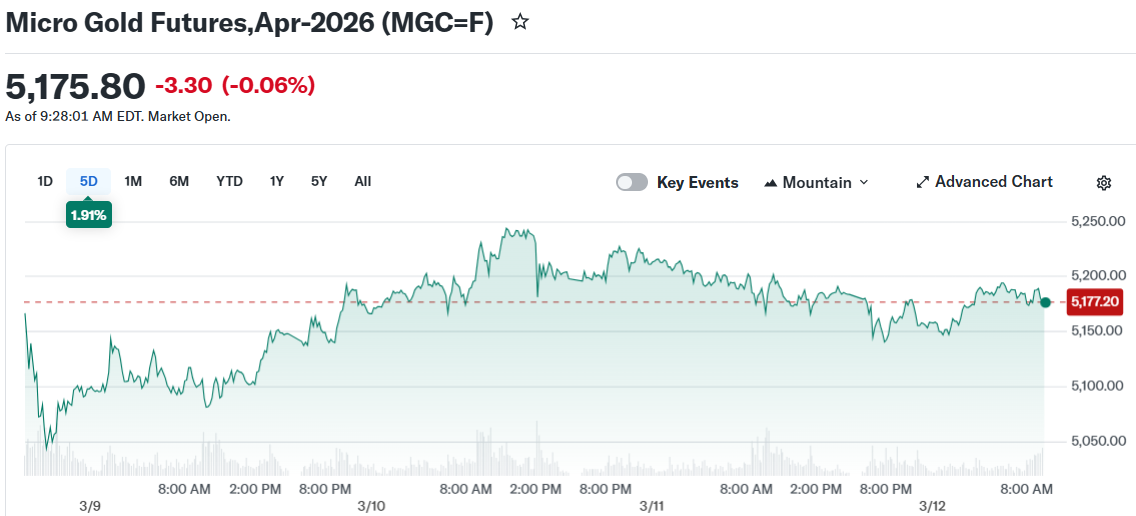
Spot quotations for gold showed minimal variation at $5,183.39 per ounce during Thursday’s New York morning trading window. US gold futures contracts for April delivery climbed 0.2% to $5,190.50. The precious metal has accumulated approximately 20% in gains year-to-date.
The ongoing hostilities in the Middle Eastern region represent the primary catalyst for prevailing market volatility. Reports emerged Thursday of two petroleum tankers engulfed in flames within Iraqi territorial waters in what appears to represent an intensification of Iranian assaults on regional energy installations.
Brent crude benchmark pricing momentarily surged beyond the $100 per barrel threshold throughout Asian market hours. Petroleum valuations have appreciated nearly 60% throughout the current year. Elevated oil prices amplify logistical and manufacturing expenses, which permeates into comprehensive inflation metrics.
The precious metal is extensively recognized as a protective instrument against currency devaluation. However, identical inflationary apprehensions are simultaneously diminishing projections that the Federal Reserve will implement monetary policy loosening imminently. Elevated interest rate environments enhance the attractiveness of yield-generating instruments relative to gold.
The United States dollar strengthened for a consecutive third trading session on Thursday. An appreciating dollar elevates gold acquisition costs for purchasers utilizing alternative currencies, potentially dampening demand levels.
“Gold has been range bound recently. The higher dollar index, rising treasury yields and lack of interest rate cuts are the negative factors, but the conflict in the Middle East has been generating some safe-haven flows,” said Phillip Streible, chief market strategist at Blue Line Futures.
Notwithstanding stable pricing, gold exchange-traded fund inventory levels declined last week at the most pronounced rate observed in over two years. Market participants have been liquidating gold positions to generate liquidity for covering deficits across other portfolio components.
Jeff Currie of Carlyle Group conveyed to Bloomberg Television his anticipation for gold demand amplification emerging from this geopolitical confrontation. He noted that developing market purchasers are selecting gold over United States assets to circumvent the possibility of foreign reserve seizures, comparable to actions taken against Russia in 2022.
Silver demonstrated superior performance relative to gold on Thursday, ascending 1.6% to achieve $87.19 per ounce. Silver accumulated gains exceeding 146% throughout 2025.
Research analysts at BMI project silver to average $93 per ounce across 2026. They indicated robust investment appetite is anticipated to counterbalance diminished demand from solar energy panel and jewellery manufacturing sectors at elevated pricing tiers.
Spot platinum advanced 0.7% to $2,184.00. Palladium appreciated 1.6% to $1,666.70.
Core United States inflation measurements arrived subdued at the year’s commencement, according to recently published Thursday data. However, forward-oriented inflation anxieties connected to Middle Eastern hostilities prompted traders to curtail their projections for Fed rate reductions in 2025.
Blue Line Futures’ Streible supplemented that should oil valuations stabilize or retreat, it could alleviate treasury yields and dollar strength, potentially propelling gold futures valuations higher.
The post Gold Prices Remain Anchored Near $5,180 Amid Escalating Middle East Tensions appeared first on Blockonomi.





