TL;DR:
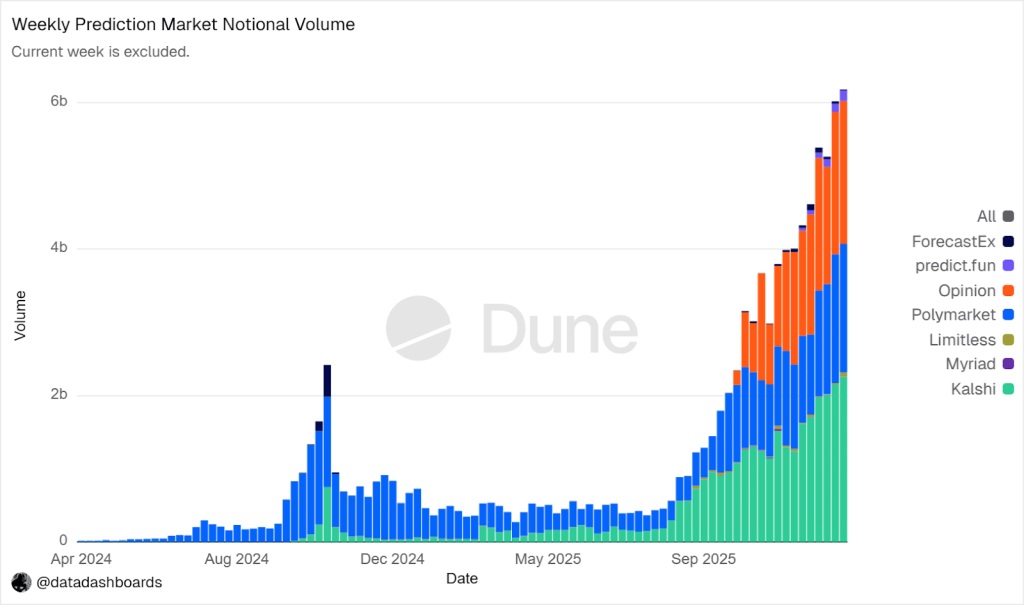
The volume of prediction markets grew more than 130 times in under two years. According to a joint report by Dune and Keyrock, monthly notional volume rose from less than $100 million in early 2024 to more than $13 billion by late 2025. This confirms that they have ceased to be a marginal experiment within the crypto industry and have become an asset class with significant participation and rising institutional attention.
Liquidity and user acquisition are no longer the main obstacles. The new limiting factor is trust, and within that concept, resolution architecture holds a central place.
In most current designs, a market is tied to a specific question in an oracle with explicit resolution criteria. Users trade conditional outcome tokens that can only be redeemed once the oracle finalizes the result. Optimistic oracle designs assume correctness by default, but require the proposer to post an economic bond. That bond creates a real financial cost for anyone attempting to submit an incorrect answer.
If a dispute arises, the case escalates to an arbitration system where decentralized juries determine the outcome. This mechanism turns resolution into auditable financial infrastructure, not a discretionary decision.
David Azubike, lead analyst at Blocksquare, argues that this transition replicates what happened with custody, execution and settlement in earlier stages of the crypto ecosystem: functions that began as product features and ended up becoming system properties that institutions demand to be predictable.
Prediction markets are expanding into increasingly complex domains: sports, politics and macroeconomics, all with outcomes susceptible to interpretation. As the surface area for ambiguity grows, the frequency of disputes increases as well.

When resolution is slow or arbitrary, serious capital retreats toward the most visible markets and abandons the rest. By contrast, when rules are explicit, bond sizes scale with open interest and resolution latency is treated as a product metric, prediction markets stop behaving like speculative instruments and begin functioning as financial systems in which users place structural trust.





