President Donald Trump announced late Friday that the United States will impose an additional 100% tariff on all imports from China. The announcement came after regular trading hours and sent technology stocks lower in extended trading.
*TRUMP: US WILL IMPOSE 100% TARIFF ON CHINA STARTING NOV 1
Welcome back to the trade war. pic.twitter.com/clooxnR8zc
— Geiger Capital (@Geiger_Capital) October 10, 2025
The tariff will be added on top of any existing tariffs Chinese goods currently face. Trump also said the U.S. will implement export controls on critical American-made software starting November 1.
The announcement followed a day of steep market losses. The Dow Jones Industrial Average fell 878 points or 1.9% to close at 45,479.60.
The S&P 500 dropped 182.60 points or 2.7% to 6,552.51. The Nasdaq Composite lost 820.20 points or 3.56% to end at 22,204.43.
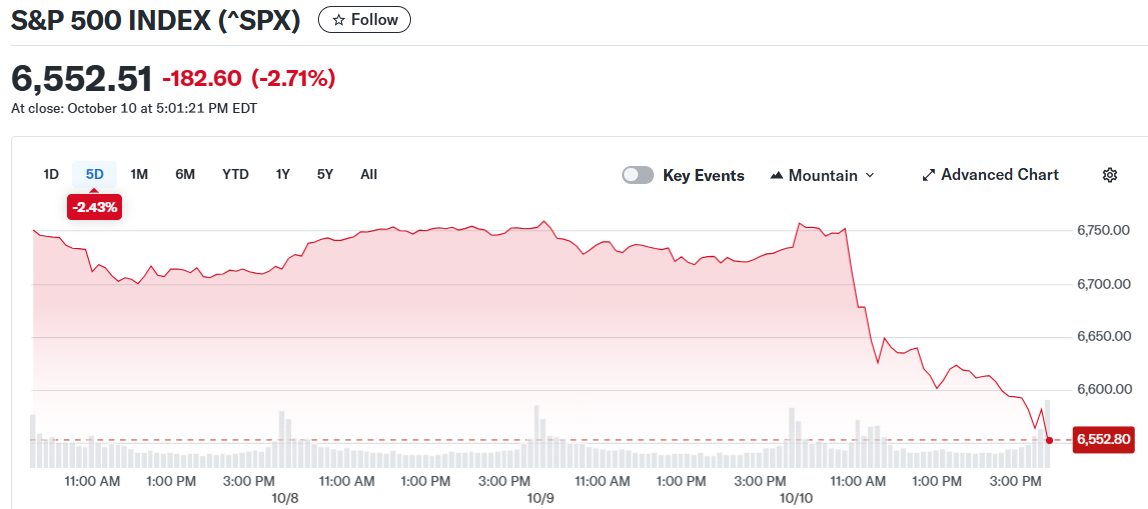
Both the S&P 500 and Nasdaq posted their largest single-day percentage drops since April 10. All three indexes erased their weekly gains and logged their worst week in months.
Earlier Friday, Trump posted on Truth Social that he was considering “a massive increase in tariffs” on Chinese products. He also said there was no reason to meet with Chinese President Xi Jinping in two weeks as previously planned.
What just happened?
At 10:57 AM ET, President Trump canceled his meeting with China and said "massive" tariff increases are coming.
40 minutes later, the S&P 500 erased -$1.2 TRILLION of market cap.
Is this dip a BUYING opportunity? Let us explain.
(a thread) pic.twitter.com/00Y8SKungk
— The Kobeissi Letter (@KobeissiLetter) October 10, 2025
China produces over 90% of the world’s processed rare earths and rare earth magnets. These materials are essential for electric vehicles, aircraft engines, and military radars.
Beijing announced new rare earth export restrictions on Friday. China also moved to impose a special port fee on U.S. vessels.
Chinese regulators launched an antitrust investigation into U.S. semiconductor maker Qualcomm. The probe focuses on Qualcomm’s acquisition of Israeli company Autotalks.
Qualcomm shares fell 7.3% during regular trading. U.S.-listed Chinese company stocks dropped sharply, with Alibaba, JD.com, and PDD Holdings down between 5.3% and 8.5%.
The Philadelphia Stock Exchange Semiconductor Index dropped 6.3%. Chip stocks faced heavy selling pressure throughout the day.
Advanced Micro Devices fell 7.7% while Broadcom dropped 5.9%. After the closing bell, additional losses hit major technology names.
Nvidia, Tesla, Amazon, and Advanced Micro Devices all fell more than 2% in after-hours trading. Regional bank stocks also slumped on concerns about economic growth.
The CBOE Volatility Index reached its highest closing level since June 19. This index measures expected market turbulence.
Bitcoin rose above $122,000 before pulling back to $102,000 on Binance late Friday. Gold climbed back toward $4,000 per troy ounce.
Oil prices tumbled 4% as Israeli troops began withdrawing from Gaza. Oil now trades at its lowest levels since the weeks following Liberation Day on April 2.
The U.S. government remains in its 10th day of shutdown. This has created a data blackout with official economic indicators postponed.
The University of Michigan released preliminary October consumer sentiment data. The reading shows sentiment near historic lows as consumers worry about high prices and weakening job prospects.
Major banks including JPMorgan Chase, Goldman Sachs, Citigroup, and Wells Fargo will report quarterly earnings Tuesday. Analysts expect third-quarter S&P 500 earnings growth of 8.8% year-over-year.
The post Why Did Stocks Drop Today? Let’s Dive In appeared first on CoinCentral.