TL;DR:
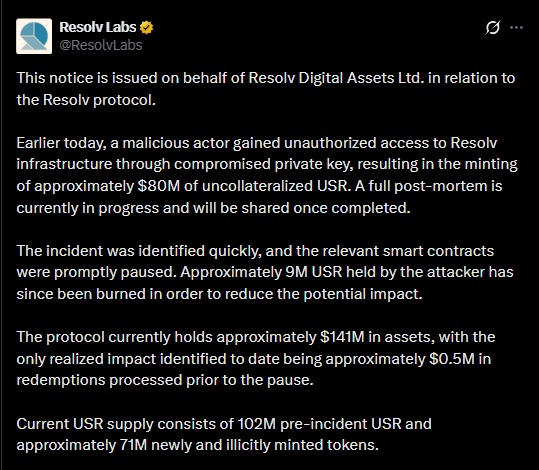
On Sunday, March 23, 2026, Resolv suffered one of the most significant exploits of the year in the DeFi ecosystem. An attacker exploited a flaw in the minting system of the protocol’s native stablecoin, USR, to generate 80 million tokens without real collateral backing. The operation allowed them to drain approximately $23 million in Ethereum before the team could suspend mint and redemption functions.
The attack vector did not reside in the delta-neutral logic that underpins USR’s design, but in the compromise of private keys from the key management service hosted on Amazon Web Services. According to Chainalysis, the attacker used between $100,000 and $200,000 in collateral to generate the tokens, implying a fraudulent issuance ratio of up to 500 times the legitimate amount. The minting contract lacked oracle verification and maximum issuance limits, which facilitated the operation.
The USR token, designed to maintain parity with the dollar, crashed to $0.02 within minutes of the first anomalous mint. Although it partially recovered ground, it continued trading well below its peg for hours. The RESOLV governance token fell 8.5% in 24 hours.
The damage spread rapidly to interconnected protocols. Morpho, which operates under a curators model that manages vaults with their own parameters, received one of the hardest blows. At least 15 vaults with more than $10,000 in liquidity recorded direct losses from exposure to USR or related assets. Curators Gauntlet, Re7 Labs, kpk, and 9summits operated pools with that exposure. In some cases, automated liquidity provision systems remained active for hours after the exploit, compounding the damage. Merlin Egalite, co-founder of Morpho, clarified that the base protocol’s contracts presented no vulnerabilities.

Lido confirmed that funds in Lido Earn were not affected. Stani Kulechov, founder of Aave, noted that the protocol had no direct exposure to USR. Deddy Lavid, CEO of Cyvers, delivered a pointed remark about the incident: “If you’re not monitoring minting and supply in real time, you’re blind when it matters most.”
The Resolv exploit illustrates that fourteen audits and a $500,000 bug bounty program on Immunefi prove insufficient if the operational management of private keys and controls over privileged roles are not held to the same standard.





