TL;DR:
Ronin, the gaming-focused blockchain developed by Sky Mavis and known as the infrastructure behind Axie Infinity, will execute a hard fork to migrate from an independent sidechain to an Ethereum Layer 2 network based on the OP Stack, the same framework that powers Base and Optimism.
The transition will generate approximately 10 hours of downtime during which all transactions, including transfers, swaps and smart contract interactions, will be suspended. Games running on the network, among them Axie Infinity and Pixels, will also be affected.
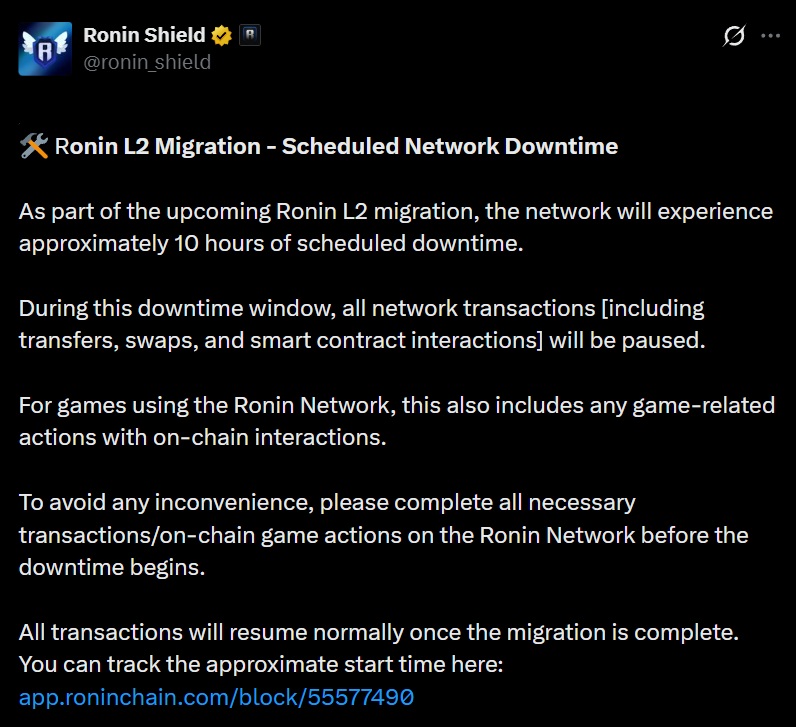
The migration was announced in April and will be executed starting at block 55,577,490, scheduled for 15:16 UTC on Tuesday according to onchain data. “Four years ago we launched Ronin because Axie Infinity needed a faster and more efficient network,” the team declared at the time of the announcement. “It’s time to reconnect with the mothership.”
The most immediate change affects the project’s tokenomics. The upgrade will introduce a “Proof of Distribution” model that replaces passive staking with rewards tied to active contribution to the network, cutting the annual inflation of the RON token from over 20% to less than 1%. In addition, 90 million RON that were earmarked for staking rewards will be redirected to the Ronin Treasury, and marketplace fees will increase from 0.5% to 1.25%.

The decision to migrate to Layer 2 carries a backdrop that is difficult to ignore. In March 2022, while operating as a sidechain, Ronin suffered the largest bridge exploit in the history of the DeFi ecosystem: attackers linked to the Lazarus Group from North Korea stole approximately $625 million in ETH and USDC through compromised validators. Sky Mavis subsequently raised $150 million from Binance to reimburse affected users. U.S. authorities and Chainalysis recovered $30 million, and Norway returned an additional $5.7 million in 2024.
Despite the 30% rally RON recorded over the past 30 days, the token trades at around 11 cents with a market capitalization of approximately $89.5 million, well below its 2024 peak. On another note: according to an April 2026 analysis by Caladan, 93% of blockchain gaming projects launched since 2020 are today practically inactive.





