Sivers Semiconductors has put up one of Europe’s most eye-catching stock moves of the year. The Swedish photonics and RF chipmaker gained roughly 50% across two trading sessions this week — all off the back of a $6.6 million U.S. defense grant and a wave of momentum from investors betting on AI infrastructure.
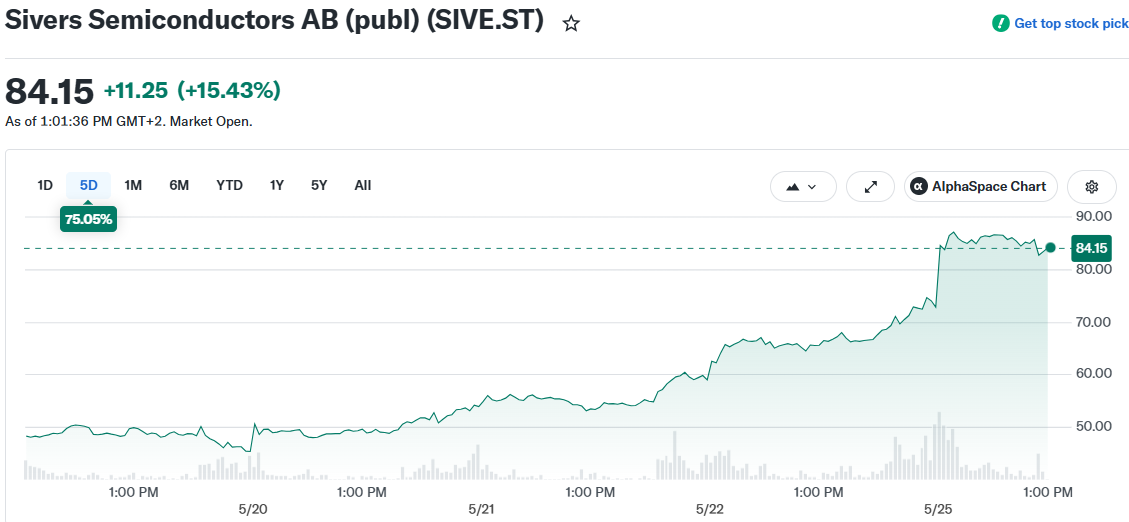
By Monday’s close, the stock was at 87.70 Swedish kronor, up 20.30% on the day. That followed a 23.45% jump in the prior session from 72.90 kronor. Those moves pushed the company’s market cap to roughly 21.54 billion Swedish kronor.
The catalyst was the second-year award under the EW STAR project, part of the U.S. Microelectronics Commons program and funded through the CHIPS and Science Act. The Pentagon-backed grant flows through the Northeast Microelectronics Coalition Hub, a network covering eight northeastern U.S. states. Crucially, the funding is performance-based — Sivers only received it after hitting technical milestones in year one, which gives it some credibility as a proof point.
EW STAR focuses on broadband antenna arrays capable of simultaneous transmission and reception for electronic warfare, radar, and communications. Sivers is also pitching the underlying beamforming and photonic technology into satellite links and AI data center applications — the two areas where investor appetite has been hardest to satisfy lately.
Monday’s 20% surge came with no fresh corporate announcement. The prior days had brought governance updates — a proposed board reshuffle that would add two new directors with capital markets and tech scaling backgrounds, while removing several founders and early backers. The new nominees, Joakim Nideborn and Helena Svancar, fit the company’s repositioning around U.S. markets and AI infrastructure.
The board changes also reflect pressure building from multiple directions. Achilles Capital, Sivers’ largest individual shareholder, is linked to DDM Finance, which has entered debt restructuring and is looking to offload €30–50 million in assets. Whether Sivers stock is part of that package is unclear. On the short side, Voleon Capital holds a 1.86% position and Two Sigma 1.78%.
The financial picture is complicated. Sivers restated accounts for both 2024 and 2025 to bring them in line with U.S. PCAOB standards ahead of a planned Nasdaq dual-listing. For 2025, revenue came in at 306.6 million kronor, but the operating loss widened to 177.8 million kronor and the net loss hit 222.6 million kronor — wider than the 186.5 million originally reported. The 2024 restatement was more severe, cutting revenue from 243.7 million to 219.2 million kronor and pushing the net loss from 116.3 million to 183.9 million kronor.
On top of that, Sweden’s Economic Crime Authority is investigating possible insider trading. An anonymous social media account with a large following posted details of the Nasdaq listing plan roughly 48 hours before the official announcement, triggering unusual price movement. Prosecutor Jonas Myrdal is examining whether EU Market Abuse Regulation was breached.
Despite all of this, the stock trades at a price-to-sales multiple of 59.69 and a price-to-book of 20.00. The average analyst price target sits at just 6.55 Swedish kronor — a long way from where the stock is now.
Sivers has delayed its Q1 report to May 29 and has an annual general meeting on June 15, where shareholders will vote on a management incentive plan covering up to 7 million stock options, representing around 2% dilution.
The post Sivers Semiconductors (SIVO) Stock Surges on Pentagon Deal as Insider Probe Clouds Nasdaq Push appeared first on CoinCentral.





