SK Hynix had a strong start to 2026. The South Korean memory chip maker reported its highest-ever quarterly profit on Thursday, driven by soaring prices for AI memory chips.
SK HYNIX Q1’26 EARNINGS HIGHLIGHTS
Revenue: $35.6B (Est. $35.1B)
; +60% QoQ / +198% YoY
Q2 Guide:… pic.twitter.com/XsdMdK04KM
— Wall St Engine (@wallstengine) April 22, 2026
Net profit hit 40.3 trillion won ($27.2 billion) in Q1, blowing past the 29.4 trillion won analyst estimate. Revenue came in at 52.58 trillion won — just short of the 53.55 trillion won forecast, but still a near-tripling from a year ago.
Operating profit rose fivefold year over year and nearly doubled from the previous quarter. Operating margin reached 72%, also a record.
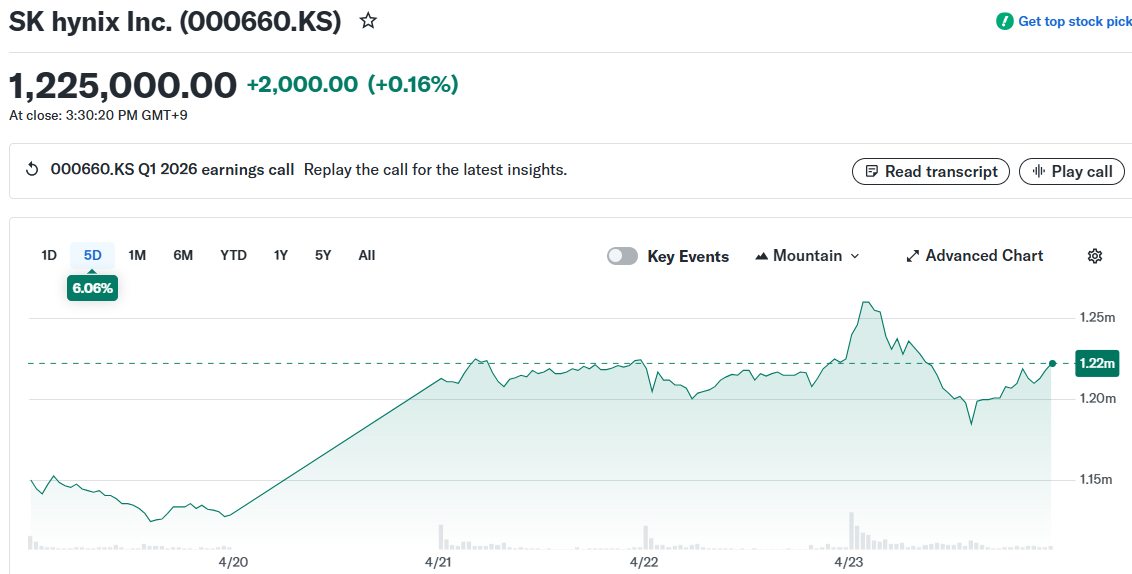
The company’s stock rose as much as 3.6% in early Seoul trading before pulling back slightly to trade down 0.9%.
SK Hynix credited the results to rising memory prices and accelerating demand from AI infrastructure buildouts. Despite Q1 typically being a seasonal slowdown, the company said demand showed no signs of easing.
“Strong demand persisted due to expanded investments in AI infrastructure,” the company said in its earnings release.
SK Hynix is the world’s top supplier of high-bandwidth memory, a key component in AI servers. It holds a 57% share of the HBM market and is a primary supplier to Nvidia.
HBM demand has been so strong it has constrained production capacity, which in turn has pushed up prices for conventional DRAM chips as well. The DRAM market recorded 30% quarter-over-quarter growth for two straight periods, according to Counterpoint Research.
The company’s head of DRAM marketing warned that the pricing tailwind could be “more prolonged compared with the past,” as suppliers struggle to keep pace with demand.
Samsung reclaimed the top spot in overall DRAM revenue from SK Hynix in Q4 2025, per Counterpoint data. But SK Hynix has kept its grip on the HBM segment, where margins are higher.
Samsung announced in February it had started shipping its first HBM4 chips. SK Hynix had already delivered HBM4 samples nearly a year earlier, and on Thursday said it plans to ship samples of its seventh-generation HBM4E in the second half of 2026, with mass production targeted for 2027.
The company announced plans to invest 19 trillion won in a new manufacturing facility in Cheongju, South Korea.
SK Group Chairman Chey Tae-won has said the global chip wafer shortage could persist until 2030, with capacity expansions taking four to five years to come online and a projected shortfall exceeding 20%.
On the supply risk side, the ongoing Middle East conflict has raised questions about access to materials like helium, bromine, and tungsten. SK Hynix said it has diversified its supplier base and built up sufficient inventory, with limited production impact expected.
Long-term liquefied natural gas agreements are also in place to help manage energy cost exposure.
Analyst MS Hwang at Counterpoint Research told CNBC that Q1 results from memory companies “show strong profitability and reveal that a lot more memory is needed for AI inference than expected.”
Mirae Asset Securities analyst Kim Young-gun said he expects SK Hynix’s earnings momentum to stay strong through 2026, pointing to multi-year supply agreements being signed with major tech customers — some of whom are even seeking extensions beyond initial contract terms.
The post SK Hynix Stock Rises as Record Q1 Profit Fueled by AI Demand appeared first on CoinCentral.





