TL;DR
Solana developers, led by Jump Crypto’s Firedancer team, are considering removing block limits following the successful approval of the Alpenglow upgrade. The proposal, SIMD-0370, would eliminate the current fixed per-block compute unit cap, allowing blocks to scale based on validator processing capabilities. The move is designed to enhance overall network performance and encourage validators with older hardware to upgrade without penalizing smaller operators. This initiative also aims to attract more developers to build advanced decentralized applications on Solana, further expanding the ecosystem.
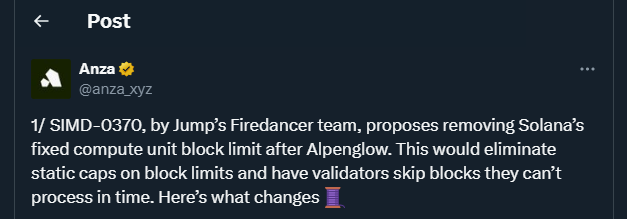
Solana Research firm Anza highlighted that removing static block caps could allow less powerful validators to skip overly complex blocks, leaving these tasks to higher-performing validators. This mechanism is expected to create a performance loop where blocks contain more transactions, increasing fees and network throughput. The dynamic scaling model builds upon earlier proposals, like SIMD-0286, which suggested raising the block compute unit limit to 100 million. Analysts expect that higher throughput could drive broader adoption by decentralized finance and NFT projects seeking fast and cost-efficient transactions.
The Alpenglow upgrade also brings two new consensus protocols, Votor and Rotor, which replace the previous Tower BFT and Proof of History mechanisms. Votor is designed to reduce transaction finality, while Rotor replaces the timestamping system to improve inter-validator data transfers. The upgrade is expected to bring finality times down from 12.8 seconds to roughly 100-150 milliseconds, a key milestone for applications requiring near-instant L1 confirmation.

With transaction times potentially reduced to 150 milliseconds, Solana could support high-speed applications requiring cryptographic certainty. The upgrade includes a skip-vote feature to allow slower validators to abstain from voting on blocks they cannot process in time, preventing network disruption. Jump Crypto and Anza will oversee ecosystem governance and Alpenglow deployment, respectively, while the community prepares for testnet activation in December 2025 and mainnet launch in Q1 2026. The new enhancements may also attract institutional developers looking for scalable blockchain solutions capable of handling complex workloads efficiently.
Analysts note that while the upgrade incentivizes hardware improvements, it could also drive centralization if smaller validators cannot keep pace.





