TL;DR:
The way traders respond to global macroeconomic shocks is undergoing a structural transformation. A report published by Bitget in conjunction with quantitative analysis firm Block Scholes documents how active traders are abandoning fragmented platforms to migrate toward environments that allow seamless movement across different asset classes on a continuous basis, without depending on traditional market hours. The data covers the first quarter of 2026, with Asia as the undisputed protagonist.
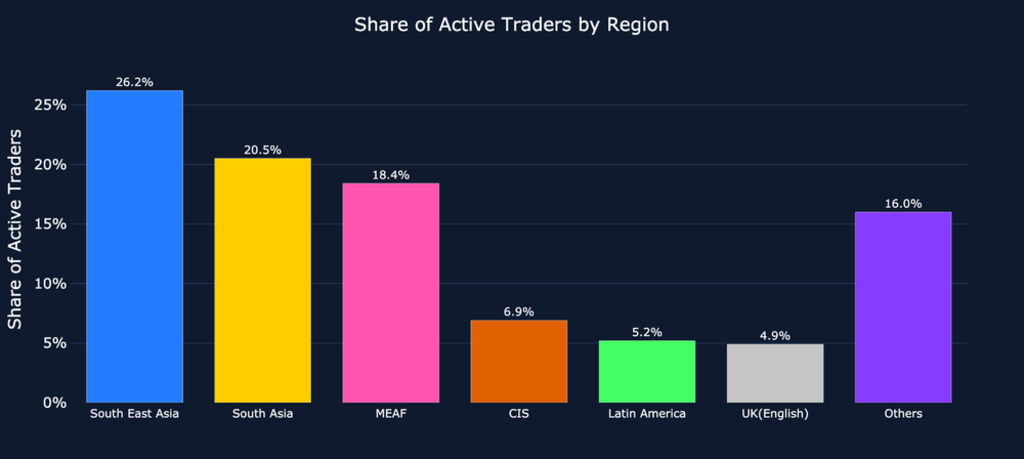
Southeast Asia accounts for 26.2% of active traders on Bitget, a platform operating across 150 regions with over 125 million users worldwide. It is followed by South Asia with 20.5% and the Middle East and Africa with 18.4%. However, this concentration becomes even more pronounced when the analysis focuses on tokenized real-world assets: Southeast Asia represents 81.9% of total RWA volume on the platform.
Bitget’s tokenized traditional finance products reached $2 billion in daily volume just days after launch, then doubled to $4 billion and surpassed $6 billion during the quarter’s volatility peaks. The report identifies a specific episode as a case study: when Middle East tensions sustained demand for safe-haven assets, volumes in gold-linked contracts spiked sharply on the platform, as traders began executing hedges outside any conventional trading session.
“Modern traders no longer wait for markets to open — they know they never close,” said Gracy Chen, CEO of Bitget, in a statement. The executive noted that tokenization enables trading in stocks, gold, silver, and commodities around the clock.

The report also finds that the correlation between Bitcoin and major stock market indices reached its highest level since late 2025, a phenomenon Block Scholes links to emerging markets responding to the same macroeconomic drivers. This alignment is key to understanding the logic of managing cryptocurrencies and traditional assets within a single operational ecosystem.





