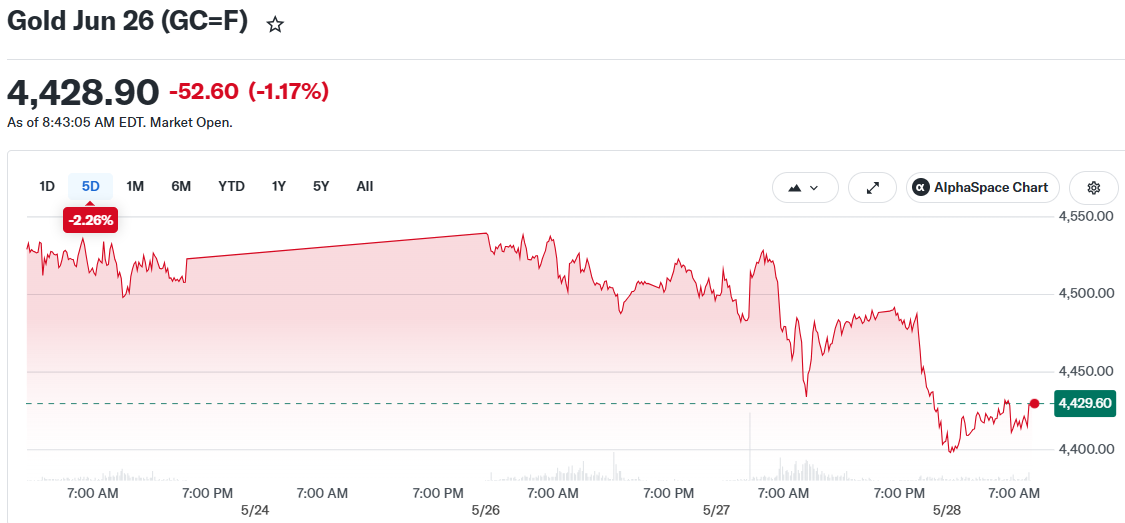
Gold fell sharply on Thursday, dropping to its lowest point in two months. The move came after fresh U.S.-Iran strikes pushed oil higher and brought inflation fears back to the front of investors’ minds.
Spot gold dropped 1.4% to $4,392.88 an ounce. Gold futures fell 1.3% to $4,423.37 an ounce. The decline broke gold out of the $4,400 to $4,600 range it had been trading in since mid-May.
Iran’s Islamic Revolutionary Guard Corps said it struck a U.S. airbase in Kuwait on Thursday. The attack was in retaliation for earlier U.S. strikes on the Iranian port city of Bandar Abbas.
At 10:17 p.m. ET on May 27, Iran launched a ballistic missile toward Kuwait that was successfully intercepted by Kuwaiti forces. This egregious ceasefire violation by the Iranian regime occurred hours after Iranian forces launched five one-way attack drones that posed a clear…
— U.S. Central Command (@CENTCOM) May 28, 2026
Kuwait confirmed its air defenses were active against incoming missiles and drones. Officials did not name the source of the attacks publicly.
This marks another escalation in a conflict that has been running for roughly three months. Washington has continued to describe its actions as defensive while also claiming a ceasefire is in place.
Earlier in the day, President Donald Trump dismissed reports that Iran would reopen the Strait of Hormuz to commercial shipping within a month. He also said he was not satisfied with current proposals for a peace deal.
Oil prices rose again following the latest exchange of strikes. They remain below $100 a barrel but are well above where they stood before the conflict began.
Higher oil prices tend to feed into broader inflation. If energy costs stay elevated, central banks may feel pressure to raise interest rates.
That is a problem for gold. The metal does not pay interest or dividends, which makes it less attractive when rates are rising or staying high.
“Rates markets are still displaying elevated central bank pricing,” analysts at ING said in a note.
The relationship between gold and interest rates is direct. When borrowing costs are expected to stay high, non-yielding assets like gold tend to lose their appeal.
Markets are also waiting for the U.S. personal consumption expenditures price index for April. That report is due Thursday and is one of the Federal Reserve’s preferred inflation measures.
The headline PCE rate is expected to have risen to 3.8% year-on-year in April, up from 3.5% in March. On a monthly basis, it is forecast to ease slightly to 0.5% from 0.7%.
Core PCE, which strips out food and energy, is expected to come in at 3.3% annually. The monthly core reading is forecast to hold steady at 0.3%.
Fed officials have been openly divided in recent weeks about whether to raise rates, hold, or begin cutting. The April PCE data could sharpen those debates.
Gold’s selloff on Thursday reflects how sensitive the market has become to any signal that inflation is not cooling fast enough.
The post Gold Prices Slide as U.S.-Iran Strikes Bring Inflation Fears Roaring Back appeared first on CoinCentral.





