TL;DR:
An unusual divergence took hold in the stablecoin market over the past 30 days: while total supply, holders and active addresses continued to grow, transfer volume collapsed.
According to data from RWA.xyz, monthly stablecoin transfer volume fell 19.18% to $8.31 trillion, in the same period in which total market capitalization grew 2.06% and reached $305.29 billion. The number of holders grew 2.32% to 246.94 million, while monthly active addresses edged up just 0.26% to 51.28 million.
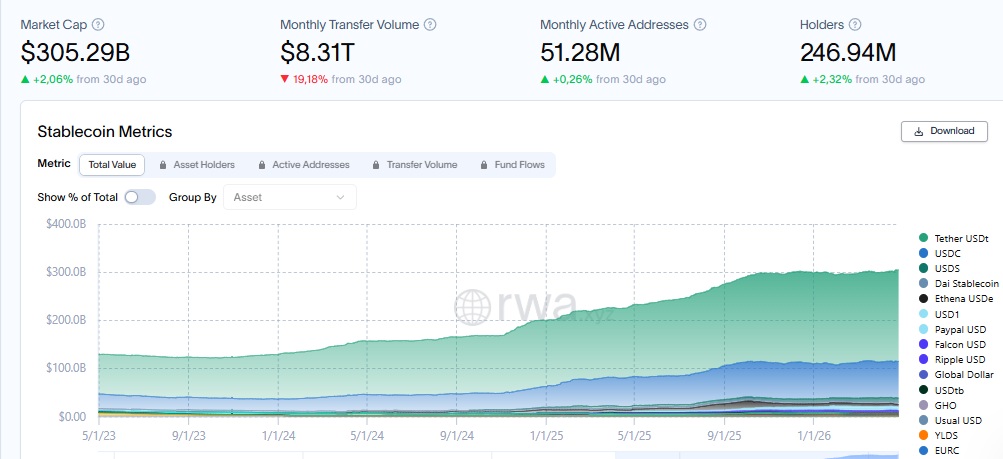
The most straightforward reading of this data is that more capital remains parked in dollar-denominated assets within blockchain networks, yet that capital moves less frequently. Accumulation is not translating into onchain activity.
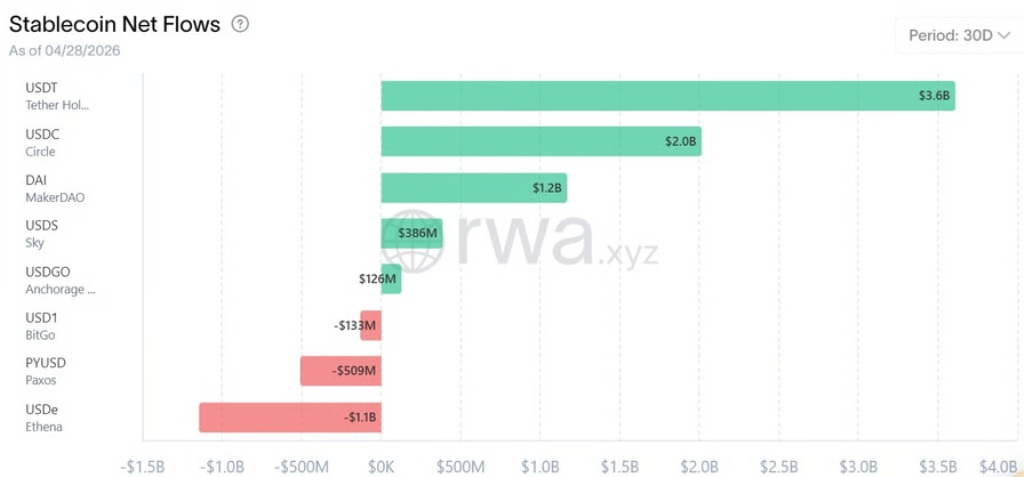
In terms of net flows, Tether’s USDT led the period with $3.6 billion in inflows, followed by Circle’s USDC with $2 billion and MakerDAO’s DAI with $1.2 billion. On the other side, Ethena’s USDe recorded the steepest outflow, shedding $1.1 billion, while Paxos’ PYUSD lost $509 million.
The decline in aggregate volume contrasts with encouraging signals recorded on specific networks. In its Q2 Signals report, asset manager Fidelity cited Coin Metrics data to note that stablecoin transfer values on Ethereum had recently surpassed their historical averages, with cumulative volume over the past twelve months exceeding $18 trillion. The firm interpreted this trend as evidence that the network is demonstrating real-world utility even under price pressure.
Solana showed a similar dynamic, though more contained. According to the same source, the network consistently processed more than $5 billion in stablecoin volume, and its 30-day transfer average climbed from $6.7 billion to $7.2 billion as of March 31. Fidelity noted that this data could indicate Solana is shifting toward more conventional financial activity, moving away from its strong association with memecoin trading.