Storj Labs, the decentralized cloud storage company, filed for Chapter 11 bankruptcy protection on July 26, 2026. The case was filed in the US Bankruptcy Court for the Northern District of West Virginia under case number 5:26-bk-00512.
Storj Labs Files for Chapter 11 Bankruptcy After Raising Approximately $35 Million
Storj Labs, the company behind decentralized cloud storage network Storj, has voluntarily filed for Chapter 11 bankruptcy protection to address legacy debt while continuing operations.
The… pic.twitter.com/UkF8qiMkB6
— Wu Blockchain (@WuBlockchain) July 27, 2026
The company said its debt problems stem from legacy obligations tied to an earlier phase of the business. Kaloyan Raev, Storj’s director of software engineering, said the business was “strong and right-sized” but held back by older financial commitments.
Storj raised about $35 million before reaching this point. That includes a $30 million STORJ token sale completed in May 2017, a $3 million seed round announced in February 2017, and additional equity funding totaling around $5 million across six rounds.
The filing came roughly nine months after data infrastructure company Inveniam announced it would acquire Storj in October 2025. Inveniam said it would continue supporting the business through the restructuring process.
Storj said it does not expect any interruptions to customer services during the Chapter 11 process. The network relies on independent storage node operators who are paid in STORJ tokens for providing storage and bandwidth.
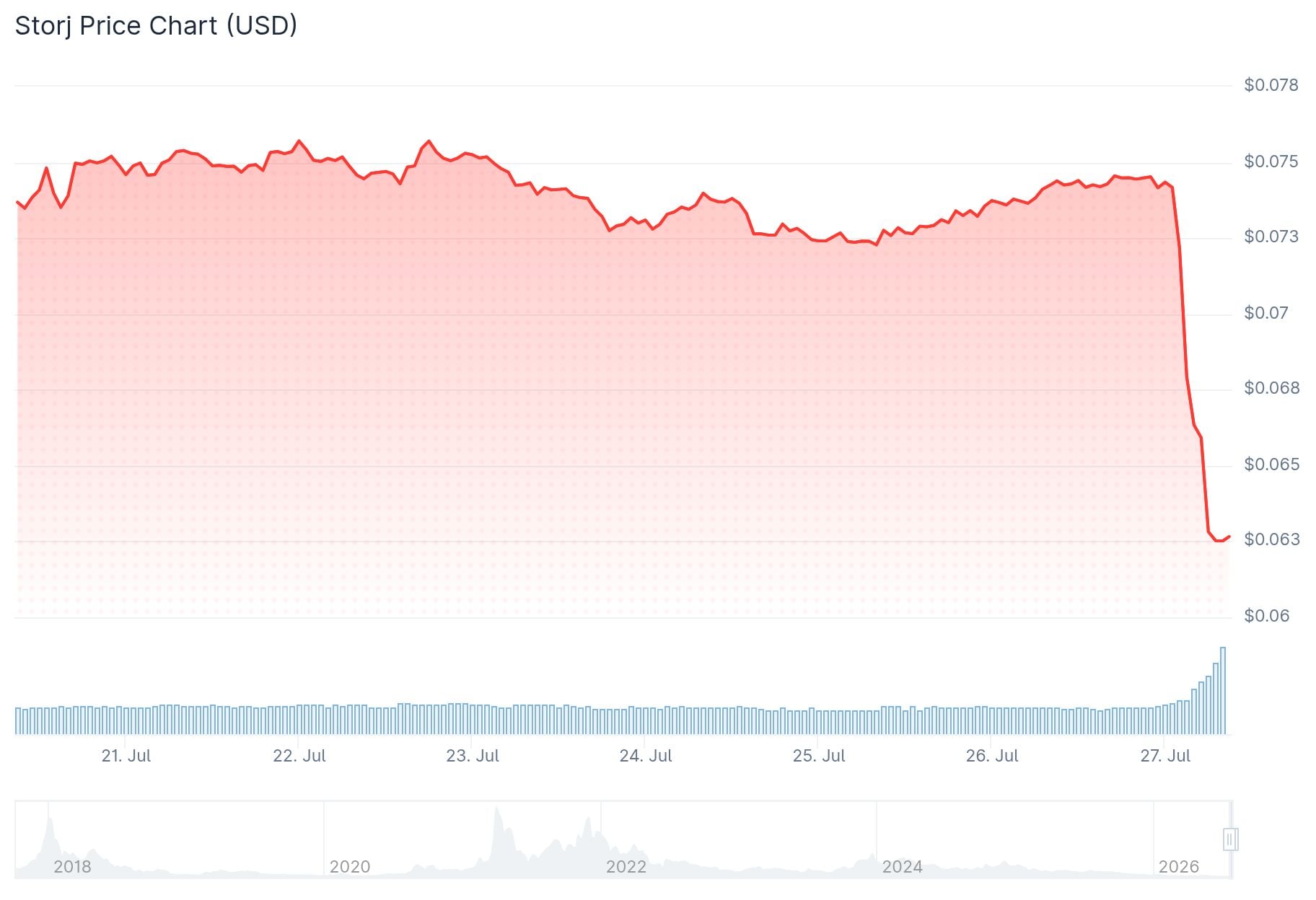
The company said the STORJ token’s utility within the network remains unchanged. The token was trading around $0.072 at the time of the filing, according to CoinGecko, with no major price movement immediately following the announcement.
Storj is also narrowing its business focus. It is disposing of earlier acquisitions and non-essential operations as part of the restructuring.
Storj said it plans to propose a mechanism that would allow STORJ tokenholders to participate in ownership of the reorganized company. Management, current investors, community members, and new investors could also be part of the proposed ownership structure.
The company has not disclosed how eligibility would be determined, whether a token snapshot or lockup would be required, or how much equity might be offered. Any plan must receive creditor approval and sign-off from the court before taking effect.
This approach differs from some other recent crypto bankruptcies. Bitcoin mining pool Poolin, which also filed for Chapter 11 in July, is pursuing a court-supervised sale of its Texas mining assets. Movement Labs filed under Subchapter V in July with liabilities potentially reaching $10 million.
Storj has not yet published a full reorganization plan, detailed creditor schedule, or final ownership terms. Future court filings are expected to provide more clarity on the company’s debts and the proposed role for tokenholders.
The post Storj Labs Raised $35M — Now It’s Filing for Bankruptcy. Here’s What Happens Next appeared first on CoinCentral.





