TL;DR:
Tempo, the Layer 1 network designed for efficient and large-scale on-chain payments, integrated USDT0 to bring unified omnichain USDT liquidity to its ecosystem. The announcement was made by the USDT0 team. This integration will be key to unifying fragmented markets into a single, interoperable liquidity layer.
The network was jointly incubated by Stripe and Paradigm, and from its early stages was warmly received by the institutional sector and companies such as Visa, Shopify and OpenAI, all with an active presence during the platform’s progressive rollout. That participant profile established Tempo as payment infrastructure oriented toward regulated, high-volume flows from day one.
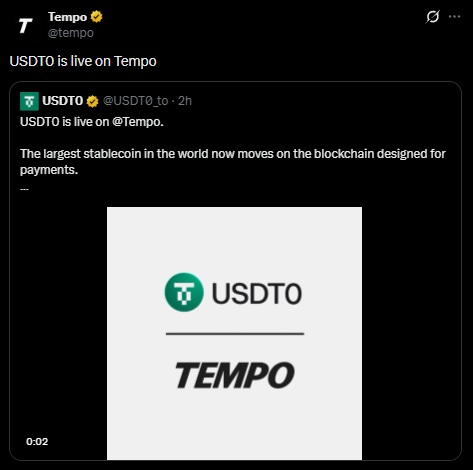
Tempo’s architecture combines sub-second confirmation times, congestion-resistant execution and a native stablecoin model that allows fees to be paid without requiring a separate gas token. This scheme directly targets the operational needs of fintech companies, e-commerce platforms and financial applications that require predictable costs and high capital turnover across payment systems and trading platforms.
The USDT0 integration will be central to that design. It connects Tempo to the same canonical USDT supply that operates across a growing network of key chains in the crypto ecosystem. According to the announcement, this eliminates reliance on third-party bridges and liquidity fragmentation, two critical factors that typically raise costs and complicate interoperability across ecosystems.
For Tempo developers and users, one of the direct benefits is access to deeper pools, tighter spreads and faster market formation through a single standard asset. The USDT0 value proposition rests on the idea that a stablecoin behaving identically across every chain where it operates simplifies product integration and reduces custom engineering at each deployment.
Tempo will become a new node within the omnichain finance infrastructure, where dollar liquidity can circulate quickly, freely and predictably across all the most widely used chains in the blockchain industry.





