TL;DR:
The decentralization of artificial intelligence continues to advance and claim its place in the industry. Tether announced the launch of QVAC SDK, an open-source software development kit designed to become the base unit of what the company calls the “Stable Intelligence Era”. The goal is to allow AI to run directly on users’ devices, without relying on cloud servers or centralized infrastructure.
The SDK is compatible with iOS, Android, Windows, macOS, and Linux. A single codebase works identically across all those environments, with no need for platform-specific adaptations. This significantly reduces technical complexity for development teams, which can focus on building products instead of managing multiple parallel implementations.
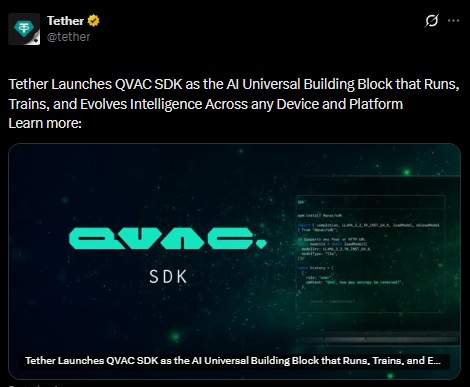
The Tether SDK infrastructure is built on QVAC Fabric, a fork of llama.cpp, and is compatible with the ecosystem of text generation models, embeddings, and multimodal workloads. Specialized engines are also integrated, including whisper.cpp and Parakeet for voice transcription, and Bergamot for on-device translation, all exposed through a unified API.
For end users, the most direct impact lies in privacy: everyday functions such as writing assistance, translation, image generation, or financial planning can be executed locally without data ever leaving the device. The system continues to work without an internet connection or if an external server goes offline.
The peer-to-peer component, powered by Holepunch technology, enables the decentralized distribution of models, delegated inference without centralized infrastructure, and lays the groundwork for distributed training and fine-tuning models. All of this operates transparently and uniformly across platforms.
Paolo Ardoino, CEO of Tether, stated that “latency limited by the speed of light, single points of failure, and concentration of control are features of a system designed for a smaller world,” and that QVAC is built for the world that lies ahead. The company also announced that it will allocate resources to expand the ecosystem toward specific toolkits for robotics and brain-computer interfaces.





