TL;DR
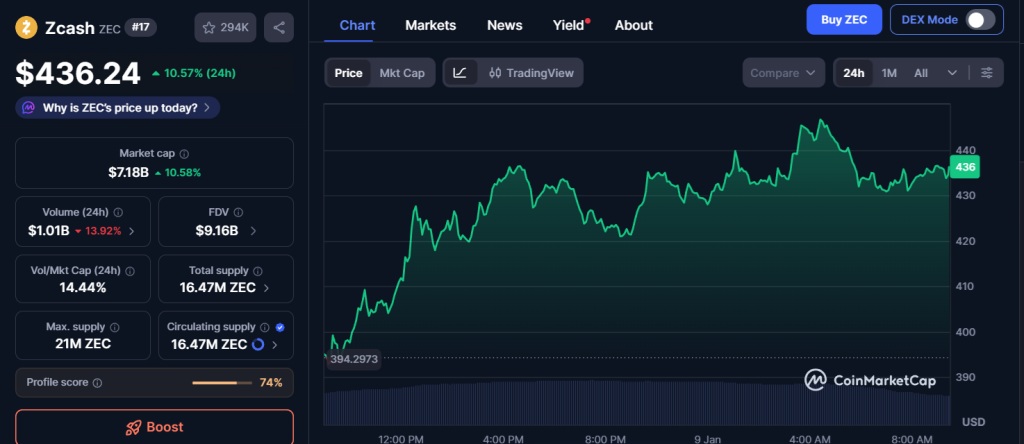
The core team of Electric Coin Company (ECC) resigned en masse following governance conflicts with Bootstrap Project, the nonprofit organization that owns ECC. The decision triggered an immediate sell-off in Zcash (ZEC), which fell 20% in a single day. However, according to the latest data from CoinMarketCap, the token has since rebounded, posting a 10.5% gain and trading at $436.24 per unit.
The Foundation confirmed that Zcash remains a decentralized, open-source protocol. No contributor, team, or entity controls the network. It emphasized that internal changes within a single organization do not affect the health or continuity of the blockchain. The network continues to operate normally: blocks are produced, transactions are settled, and user privacy remains a priority and stays protected.
Josh Swihart, CEO of ECC, explained that the resignation stemmed from fundamental disagreements with Bootstrap’s board regarding roadmap execution and alignment with ECC’s mission. Despite the team’s departure, Zcash Foundation stressed that the network was designed for resilience. Its codebase is open source, consensus rules are enforced by independent nodes, and a diverse group of organizations and developers maintains the protocol’s integrity.
Zooko Wilcox-O’Hearn, founder of Zcash, stated that the network is open, secure, private, and permissionless, and that no organizational conflict can alter these characteristics. The Foundation reaffirmed its mission: to maintain protocol development, fund independent research and engineering, support decentralization across infrastructure and governance, and defend privacy as a fundamental right.

The Foundation underscored that Zcash’s decentralization is not theoretical. It is backed by a global network of independent nodes, developers, researchers, and users committed to financial privacy. The protocol operates continuously, reliably, and securely, does not depend on the fate of any single organization, and ensures that the network remains stable and resilient despite internal changes





