TL;DR
The discussion about the impact of quantum computing on Bitcoin is evolving in a different direction. The debate is no longer centered on whether the technology will break the protocol’s current signatures, but on how a community without a central authority will react when that moment arrives.
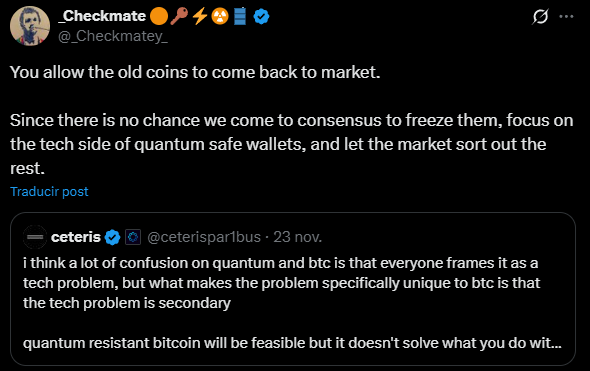
Analyst James Check argues that the real risk does not lie in the code, but in Bitcoin’s internal politics, because the network is unlikely to reach consensus to freeze or invalidate old coins once quantum attacks become practical. This interpretation shifts the threat from a technical issue to an economic one, as it opens the possibility that forgotten, inaccessible, or simply inactive addresses could be drained by malicious actors.
Data from BitBo highlights the scale of the issue: 32.4% of all BTC has not moved in five years, and 16.8% has remained untouched for more than a decade. Some of those coins may belong to users who still possess their keys, but no one knows how many are effectively lost.
If legacy addresses remain without upgrading to post-quantum schemes, those balances will be exposed once hardware emerges that can derive private keys from ECDSA or Schnorr signatures. Analyst Ceteris Paribus also maintains that the core issue is not whether the industry can build quantum-resistant cryptography—NIST has already standardized algorithms for that—but deciding what to do with the large stock of coins that never migrate to the new system.

Adam Back had already warned that the community will have to choose between allowing those funds to be stolen or depreciating old addresses through a rule change. Neither option is neutral, because the first would unleash massive selling pressure, while the second would represent a departure from one of Bitcoin’s foundational principles: coins properly secured would continue to be valid without additional conditions. Back even suggested that a mass migration might reveal whether addresses attributed to Satoshi Nakamoto are still under someone’s control.

Other networks like Sui, Cosmos, Near, or Solana already have zero-knowledge proof systems that enable backward-compatible migrations. Bitcoin, however, does not have a simple way to protect legacy balances without requiring a traditional signature that would expose public keys. In that scenario, the quantum computing debate becomes a test of the network’s governance model and the economic value of its historical coins.





